NSW Plastics Plan 2.0 - November 2025

NSW Plastics Plan 2. Published by the NSW Environment Protection Authority www.epa.nsw.gov.au
First published: November 2025 ISBN/ISSN: 978 1 923328 41 9
Department or Agency reference number: EPA 2025P4639
Copyright and disclaimer
© State of New South Wales through the NSW Environment Protection Authority 2025. Information contained in this publication is based on knowledge and understanding at the time of writing, November 2025, and is subject to change. For more information, please visit https://www.epa.nsw.gov.au/About-us/Contact-us/Website-service-standards/copyright.
Contents
A circular approach............................................................................... 3
Phasing out unnecessary and harmful plastics............................................ 4
Scaling up reusable alternatives to single-use plastics............................. 8
Our actions........................................................................................... 8
Designing for recycling.......................................................................... 10
Our actions................................................................................... 11
Collecting materials for recycling.......................................................... 11
Our actions.................................................................................. 13
Reducing pollution of the environment and contamination of recycling streams..14
Improving disposal behaviour.................................................................. 14
Our actions......................................................................................... 15
Designing out harmful chemicals............................................................. 15
Our actions......................................................................................... 17
Reducing microplastic pollution.............................................................. 17
Our actions......................................................................................... 18
Timeline for implementation................................................................... 19
Tracking our progress............................................................................ 21

Minister’s message
We use items that contain plastic daily. While these items provide many benefits, they are often designed to be used only once and then thrown away. And once they are thrown away, they can persist for centuries in landfill or the environment.
The harm caused by plastics in our environment is well established. Plastic litter in our waterways can be lethal to wildlife. It pollutes the places we enjoy, like our local parks and public spaces, forcing local governments to clean it up at a considerable cost to the community. It’s a cost they could do without.
Evidence is also growing about the risks posed by microplastics. These tiny plastic fragments are present in almost every part of the environment and are being found with regularity in human bodies. As plastic items break up into microplastics, they can also release potentially harmful chemicals that can contaminate our soil, waterways, and recycling streams.
In response to the plastic pollution crisis, the NSW Government released a draft action plan, NSW Plastics: The Way Forward, for consultation in September 2024. Since that time, our understanding of the challenges facing NSW’s transition to a circular economy have become clearer.
Landfills across the state are approaching capacity, meaning essential waste services such as red kerbside bin collections could be disrupted by 2030. We’ve already started tackling this landfill crisis head-on through the NSW Waste and Circular Infrastructure Plan, but we can’t address this issue with infrastructure alone.
Designing out waste in the first instance and then finding ways to increase reuse and recycling will ensure that we avoid a waste crisis by keeping materials out of landfill and in use for longer. Our priority remains focused on generating less waste and changing the way products are made so that more of what we consume is reused and recycled, not littered or landfilled.
Only about 15.6% of the plastic waste generated in NSW is recycled.1 And 74% of the littered items in our urban estuaries are plastic.2 As the least recycled and most littered material in NSW, how we respond to the plastic crisis will play a crucial role in overcoming the waste management challenges ahead.3
We cannot wait any longer to act. For this reason, I am pleased to share this Government’s NSW Plastics Plan 2.0.
This plan is a finalisation of NSW Plastics: The Way Forward, and draws on the valuable feedback we heard from individuals, community groups, environment organisations, businesses, and industry bodies. Thank you for sharing your insights into how we can achieve our shared vision for tackling plastic waste. This plan outlines the NSW Government’s system-wide approach to addressing the plastic crisis as part of our broader transition to a safe, circular economy. It sets out how we will reduce the harms of plastics in the environment by:
1. phasing out problematic and unnecessary plastic items
2. scaling up reusable alternatives to single-use plastics
3. increasing plastic waste recycling
4. reducing plastic pollution in the environment and plastic contamination in our recycling streams.
The plastic pollution crisis
Plastic is pervasive in our society, and its consumption is only increasing. But plastic items are often designed, consumed and disposed of in ways that are problematic for the health of our environment and communities and for our transition to a circular economy.
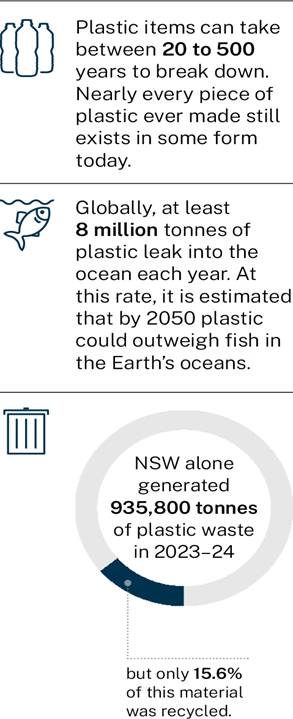
Commonly littered and landfilled plastic items are designed for disposal and only used once or twice before being thrown away. This behaviour has led plastic to be the most littered material in NSW, with single-use plastic items making up 74% of the litter found in NSW urban estuaries.4 It is also the least recycled material in NSW.5 Of the 935,800 tonnes of plastic waste generated across the state in 2023–24, just over 15.6% was recovered. This means nearly 800,000 tonnes of plastic waste was disposed of in landfill in 2023–24.6
With so much plastic being thrown away, either as litter or landfilled waste, people and the environment have become increasingly exposed to harm. Plastic litter can enter our waterways and marine environments, where they can entangle or be swallowed by wildlife with lethal effect. Plastic litter also makes our public spaces less enjoyable and comes at a high cost, a cost borne primarily by local councils, land managers, and the community.7
Plastics can also fragment over time into small plastic particles known as microplastics. Microplastics are widespread in the environment. As they break up into smaller and smaller pieces, they can leach potentially harmful chemical additives such as per- and polyfluoroalkyl substances (PFAS), phthalates and bisphenols into the air we breathe, water we drink, and soil that grows our food.8 There is evidence that microplastics and some chemical additives may have negative human health impacts, such as endocrine disruption, increasing risks of cancer, neurodevelopmental disorders, infertility, heart disease, and loss of immune function.9,10,11
Plastics that are incorrectly disposed of also threaten to undermine the viability of resource recovery in NSW. Each year, resource recovery operators recycle approximately 14.2 million tonnes of material.12 This relies on the availability of clean supplies of high-quality, recoverable material. But when plastic items, such as fruit and vegetable stickers, are thrown into kerbside green bins, microplastics and the chemicals in plastics can contaminate the material stream. This contamination persists into reprocessed products such as compost derived from organic waste. Research indicates that microplastics can impact soil health and impede plant growth, compromising agricultural productivity.13 This is a significant risk that prevents the safe and beneficial use of recovered materials and impacts the viability of resource recovery.
What we heard
On 9 September 2024, the Minister for the Environment released the NSW Plastics: The Way Forward paper seeking feedback on 29 proposals to phase out problematic and unnecessary plastics, promote more reusable and recyclable alternatives to single-use food and beverage packaging, reduce harmful chemicals in food packaging, and help drive down plastic litter in NSW.
The NSW Environment Protection Authority (EPA) conducted an 8-week consultation on the paper, encouraging NSW to provide feedback on the proposals by completing a survey or making a written submission. In response, the EPA received 2,157 completed surveys and 168 written submissions from members of the public, businesses, government, environment organisations, researchers, and the waste and resource recovery sector.
We heard resounding support for the proposed actions. On average, 90% of the people who provided feedback on the paper agreed with the 29 actions and their time frames. Given this support, the NSW Government is pleased to reaffirm its commitments to the objectives outlined in NSW Plastics: The Way Forward.
But we also heard calls for the actions to be implemented with appropriate transition times, align more closely with other states and territories, and be more ambitious. The NSW Government has given careful consideration to this feedback and updated several of the proposed recommendations in response.
A circular approach
The NSW Plastics Action Plan was released in June 2021 and established an approach to better managing plastics throughout their lifecycle. It set out actions to help NSW meet the plastic targets defined under the NSW Waste and Sustainable Materials Strategy: Stage 1 2021–2027. These included targets to phase out unnecessary and problematic plastics, triple the plastics recycling rate, and reduce plastic litter.
Since the release of the NSW Plastics Action Plan, strong progress has been made to reduce the impact of plastics on our environment and human health. For example, in 2024–25, the number of plastic litter items decreased by 45% compared to the baseline years (2018–2019), exceeding our target of a 30% reduction in plastic litter items by 2025.14
This NSW Plastics Plan 2.0 builds on this progress. It has been informed by a rich, multi-staged consultation process on the issues with problematic and unnecessary plastics and potential actions to address them, centred around the objectives of:
· reducing plastic litter in our environment, in support of our target to reduce all litter items by 60% by 2030
· protecting human health, the environment, and recycling streams from the impacts of microplastics and harmful chemicals in plastics
· harmonising with other states and territories where possible, and taking a leading role where further, faster action is needed.
Our approach embeds the core principles of the waste hierarchy: prioritising prevention, reduction, reuse, and then recycling. This means avoiding plastic waste where we can by phasing out problematic and unnecessary plastics, followed by scaling up reusable alternatives to highly littered single-use plastic items.
But not all plastic items can be safely or feasibly avoided or reused, meaning we need to look at ways to increase plastic waste recycling. This can be achieved through better product design, access to recycling collection pathways, and improved disposal behaviour that reduces contamination.
Reducing plastic waste
Phasing out unnecessary and harmful plastics
Plastic is a part of modern life. It provides many benefits, and in some cases the use of plastic items is unavoidable. But we often use plastic items that aren’t needed, or when more sustainable alternatives could be used instead.
In 2022, NSW began to tackle unnecessary and problematic plastics by phasing out the supply of items such as lightweight plastic bags; single-use plastic cutlery, bowls, plates, stirrers, and straws; and plastic microbeads in some rinse-off personal care products. These phase-outs are expected to prevent nearly 2.7 billion plastic items from entering our environment by 2042.15 Already, we have seen a steeper decline in the number of banned plastic items that are littered compared to plastic litter more generally – for example, littered plastic straws have fallen by 83% compared to baseline years (2018–2019).16
To build on this progress, the NSW Government will make regulations in 2026 to phase out other unnecessary and problematic plastic items.
These regulations will cover items such as plastic shopping bags (other than barrier bags) and confectionery sticks, which still enter and persist in our environment as litter and cause harm to our waterways and wildlife. They will also cover cleaning products that contain microbeads or items that more readily break up into microplastics, which pollute our environment and contaminate our recycling streams.
Other states and territories in Australia have phased out problematic plastic items that are still allowed in NSW. We need to act on these items as well to set the foundation for a harmonised response to unnecessary or problematic plastics across the country. This will make it easier and less costly for businesses and consumers to do the right thing while preventing NSW from becoming a dumping ground for harmful plastics that are regulated elsewhere.
The NSW Government will consider exemptions to these phase-outs and other actions set out in this plan, as appropriate.
To support enforcement efforts and help businesses and consumers to know the products they are purchasing are compliant, suppliers may be required to make, retain, and make records or information available on request.
Our actions
Table 1 Actions to phase out unnecessary and harmful plastics
|
What? |
When? |
Why? |
|
Phase out the supply of plastic confectionery sticks |
Regulations made in 2026, with a 24-month transition period before they commence |
Reduce plastic litter. Plastic lollipop sticks are frequently littered in NSW urban estuaries.17 |
|
Phase out the supply of plastics containing pro-degradant additives, such as oxo-, photo-and landfill-degradable plastics |
Regulations made in 2026, with an 18-month transition period before they commence |
Reduce microplastic pollution and align with other Australian states and territories. Plastics containing pro-degradant additives fragment quickly into microplastics under certain conditions. Microplastics are commonplace in our environment and waterways and even in our bodies. They can also contaminate recycling streams if degradable plastic products are disposed of incorrectly. |
|
Phase out the supply of all rinse-off cleaning products containing plastic microbeads |
Regulations made in 2026, with an 18-month transition period before they commence |
Reduce microplastic pollution and align with other Australian states and territories. NSW has already phased out plastic microbeads in some personal care products under the Plastic Reduction and Circular Economy Act 2021, but they are still present in some cleaning products. When these products are washed down the drain, plastic microbeads can enter wastewater, contaminate recoverable biosolids and pollute our waterways.18 |
|
Expand the current ban on lightweight plastic bags by phasing out the supply of any plastic bag with handles, regardless of thickness, with exemptions for reusable bags |
Regulations made in 2026, with an 18-month transition period before they commence |
Reduce plastic litter and align with other Australian states and territories. NSW has already phased out lightweight plastic bags under the Plastic Reduction and Circular Economy Act 2021, but plastic bags still make up 10% of all |
|
What? |
When? |
Why? |
|
such as those made from synthetic fabrics and barrier bags |
|
littered items found in NSW urban estuaries.19 |
|
Phase out the supply of plastic umbrella bags |
Regulations made in 2026, with an 18-month transition period before they commence |
Reduce plastic litter and unnecessary plastic waste. |
|
Phase out the supply of plastic pizza savers |
Regulations made in 2026, with an 18-month transition period before they commence |
Align with other Australian states and territories and reduce unnecessary plastic waste. |
|
Phase out the supply of plastic tags used to seal food bags |
Regulations made in 2026, with an 18-month transition period for bags containing bread, bakery, and dry pantry items and a temporary exemption to September 2029 for fresh produce bags |
Align with other Australian states and territories and reduce unnecessary plastic waste. |
|
Phase out the supply of non-compostable fruit and vegetable stickers. Stickers and their adhesives that meet certain requirements in line with Australian standards for compostability will continue to be allowed. |
Regulations made in 2026, to commence from January 2030 |
Align with other Australian states and territories and reduce contamination of recoverable organic waste streams. Plastic fruit stickers can contaminate organic waste recycling streams if they are thrown away with food waste. |
|
Ban the release of lighter-than-air balloons |
Introduce a Bill to Parliament in early 2026 |
Reduce plastic litter and align with other Australian states and territories. When lighter-than-air balloons are released, they can end up in waterways and be swallowed by or entangle marine animals, leading to injury or death. It is an offence to release 20 or more helium balloons in NSW under the Protection of the Environment Operations Act 1997, but balloons remain the deadliest type of marine debris for seabirds.20 |
|
Phase out the supply of plastic balloon sticks and ties |
Regulations made in 2026, with an 18-month transition period before they commence |
Align with other Australian states and territories and reduce unnecessary plastic waste. |
|
What? |
When? |
Why? |
|
Phase out the supply of loose-fill, void-fill, and moulded or cut packaging made from expanded or foamed plastic, with appropriate exemptions in line with Western Australia’s regulations |
Regulations made in 2026, with an 18-month transition period for loose-fill and void-fill packaging and a 24-month transition period for moulded or cut packaging |
Align with other Australian states and territories and reduce unnecessary plastic waste. Expanded plastic packaging such as expanded polystyrene (EPS) is difficult to recycle and instead takes up space in landfill or is littered in the environment. EPS products can easily break apart and be transported by wind and water when littered, posing a threat to wildlife. |
|
Phase out the supply of food supply and service items, such as food trays, made from expanded or foamed plastic |
Regulations made in 2026, with an 18-month transition period before they commence |
Align with other Australian states and territories and reduce unnecessary plastic waste. |
|
Work with other Australian states and territories on a national approach to regulating cigarette butts. The NSW Government is not at this stage banning plastic filters in cigarette butts. However, we remain concerned about the prevalence of plastic litter that derives from cigarette butts. We are very interested in exploring this approach for the future. |
2028, through national forums such as the Environment Ministers Meeting (EMM) |
Reduce litter and align with other Australian states and territories on a national approach to regulating cigarette butts. Cigarette butts are the most littered item in NSW, making up 40% of littered items on land.21 They contain filters made of cellulose acetate, a plastic that persists in the environment for a long time. |
Scaling up reusable alternatives to single-use plastics
Single-use plastic items are designed to be thrown away. But we can reduce plastic waste and plastic litter by ensuring everyday items are valued by businesses and consumers long after their first use. Increasing the uptake of reusable alternatives to single-use plastic items is a key part of any system-wide, circular approach to reducing plastic in landfill and in the environment.
Single-use takeaway food and beverage packaging items such as cups, bowls, and food containers and their lids are the biggest category of littered items in NSW urban estuaries, making up 24% of littered items in these areas.22 Reusable alternatives to these items are available but have not been adopted at the scale needed to fully realise their benefits.
And the benefits of reuse are many: if reusable packaging for certain items is reused enough, and has appropriate collection, washing, and return systems in place, reuse can not only reduce plastic pollution but also reduce greenhouse gas emissions, water use, and costs to retailers and consumers.23, 24, 25
The NSW Government will introduce a Bill to Parliament in early 2026 to scale up reusable alternatives to single-use plastics, starting with single-use plastic cups and their lids.
This will be supported by programs to trial reuse systems in NSW Government premises and establish reuse precincts. These actions will help to normalise reuse behaviours, build the infrastructure and systems needed to scale reusable items, and overcome the key barriers to making reuse commonplace.
Our actions
Table 2 Actions to scale up reusable alternatives to single-use plastics
|
What? |
When? |
Why? |
|
Require takeaway food service businesses such as fast-food restaurants and cafes to accept reusable cups provided by customers for takeaway beverages. The NSW Government will ensure appropriate exemptions are in place to protect food health and safety. |
Introduce a Bill to Parliament in early 2026, with a 24-month transition period from the date of assent or from 1 January 2028, whichever is earliest. |
Reduce plastic litter. Nearly 465 million single-use coffee cups are consumed in NSW each year, most of which are landfilled or littered in the environment.26 |
|
What? |
When? |
Why? |
|
Require large food service businesses that provide takeaway beverages to offer a reusable cup option as part of a reuse system. The NSW Government will work with businesses during the development of regulations to define reuse requirements and how they will apply. This will include how we define ‘large food service businesses.’ Reuse requirements in the European Union exempt micro-enterprises, which employ fewer than 10 people or have an annual turnover that does not exceed EUR 2 million (roughly AUD 3.5 million). We want to ensure our reuse requirements are appropriate for NSW businesses, so we will consult on whether these thresholds are suitable. |
Introduce a Bill to Parliament in early 2026, to commence from December 2030. |
Reduce plastic litter. This action aligns with regulations that will come into force in the European Union in 2028 and requirements that are already in force in countries such as Germany. |
|
Trial reusable cup systems in NSW Government premises, such as office buildings, stadiums and other venues |
2026 |
Reduce plastic litter and build reuse systems, infrastructure and behaviour ahead of reuse requirements coming into effect |
|
Establish a reuse-only precinct in the Sydney CBD to inform the development of resources, guidance and case studies for similar precincts in other locations |
2027 |
Reduce plastic litter and build reuse systems, infrastructure and behaviour ahead of reuse requirements coming into effect |
Increasing plastic recycling

Designing
for
recycling
Not all plastic waste can be avoided. It will take time for safe and sustainable alternatives to many single-use plastics to be developed and widely adopted. In these cases, it is important that the plastic waste that is generated is sustainably managed. This includes turning what would otherwise be disposed of to landfill or littered in the environment into a valuable recovered resource. This starts with design.
The NSW Government will make regulations in 2026 requiring highly littered takeaway food and beverage packaging items to be designed for recycling. This means designing items:
· to be made from materials that can be recovered and reprocessed into a valuable product
· without materials that may contaminate recycling processes
· to be accepted in available collection and processing systems for recycling.
Some takeaway food and beverage packaging items, particularly small items, will be harder to design for recycling than others. The NSW Government will work with industry across the supply chain to overcome these barriers and develop circular solutions for these items, including scaling up opportunities to reduce, reuse, and recycle.

Our actions
Table 3 Actions to design for recycling
|
What? |
When? |
Why? |
|
Require single-use plastic cups, single-use plastic food containers, plastic lids of single-use cups and containers, and single-serve plastic condiment packages to be designed for recycling when they reach the end of their life. Under this action, items that are currently not recyclable – such as plastic soy-sauce fish, which are too small to be recycled – will not be allowed unless they are redesigned for recycling. The NSW Government will work with businesses, the waste and recycling sector, and others during the development of regulations to prepare standards for recyclability. We will also work to ensure these standards are, as much as practicable, consistent with national standards and guidance. |
Regulations made in 2026, to commence by December 2028 for cups and food containers and by January 2030 for condiment packages |
Reduce plastic litter and increase plastic recycling. Takeaway food and beverage packaging is the biggest category of items littered in NSW. Alone, single-serve condiment packaging such as soy-sauce fish account for 3.3% of littered items found in NSW urban estuaries.27 |
|
Require plastic lids to be ‘tethered’ or attached to plastic beverage containers at or below 1.25 L, in line with European Union standards. Require plastic beverage containers with tethered lids to be recyclable, to protect the recycling outcomes of the NSW container deposit scheme, Return and Earn. |
Regulations made in 2026, to commence by December 2030 |
Reduce plastic litter and increase plastic recycling. Beverage container lids make up 5.3% of littered items in NSW urban estuaries and pose a high risk to the marine environment.28 Tethering lids to plastic beverage bottles will make it harder to separate and litter them. |
|
Work across the packaging supply chain to consult on a roadmap towards circular solutions for takeaway single-serve condiment packages and other small, hard-to-recycle, and highly littered food and beverage packaging items. |
To commence in 2026 and be completed by January 2030 |
Reduce plastic litter and identify opportunities to increase waste avoidance, reuse and recycling. |
Collecting materials for recycling
To transform highly littered waste material into a valued recovered resource, a convenient system must also be in place to incentivise the collection and processing of the material at scale. The NSW container deposit scheme, Return and Earn, is a successful example of such a system.

The NSW Government will apply learnings from Return and Earn and develop a product stewardship scheme for the collection, reuse and/or recycling of plastic takeaway cups and food containers.

Our actions
Table 4 Actions to develop a product stewardship scheme
|
What? |
When? |
Why? |
|
Develop a product stewardship scheme, such as a container deposit scheme, to accept plastic takeaway cups and food containers for reuse and recycling at scale. In designing the scheme, the NSW Government will engage with industry and consider factors such as the means of collection and placement of collection points, if a deposit is needed to incentivise return, and what requirements for the labelling and design of items are needed to reduce opportunities and incentives for fraud. |
December 2030 |
Reduce plastic litter and increase plastic recycling. |

Reducing pollution of the environment and contamination of recycling streams
Improving disposal behaviour
Single-use plastic items are often disposed of incorrectly.
Material that is recyclable can be thrown away in the red kerbside bin rather than yellow bin, resulting in valuable resources going to landfill. Conversely, items made of plastics that can’t be recycled are often disposed of in yellow co-mingled recycling bins, contaminating recycling streams and increasing the cost of separating and processing recoverable materials such as paper, cardboard and glass.
Food and beverage packaging, particularly items labelled as ‘biodegradable’ or ‘compostable’, are frequently – but incorrectly – disposed of in green kerbside organic waste bins. This can result in microplastics and chemicals additives contaminating compost made from household organic waste, preventing the safe use of this recovered resource in household gardens, public parks, playgrounds and agricultural lands.
And many single-use plastic items are not thrown in any bin at all but are instead littered in the environment.
The transition to a safe, circular economy hinges on waste being thrown away in the right bin. As such, the NSW Government will make regulations in 2026 to require clear labelling on how to properly dispose of highly littered items. Recognising that the way items are designed and marketed can influence how they are used and disposed of, the NSW Government will also take steps to reduce greenwashing and encourage brand owners and suppliers of highly littered items to take greater responsibility for the environmental impacts of their packaging at the end of its life.

Our actions
|
What? |
When? |
Why? |
|
Require labelling that discourages littering and promotes correct disposal behaviour on single-serve condiment packages, single-use plastic cups and food containers, and plastic bags that are not banned. The NSW Government will work with businesses before regulations are made to define labelling specifications and requirements. The NSW Government will also consider expanding these requirements to apply to non-plastic single-use cups and food containers, to further protect recycling and recoverable organic waste streams and reduce litter. |
Regulations made in 2026, with a 24-month transition period and a temporary exemption for condiment packages to January 2030 |
Reduce plastic litter and contamination of recycling streams |
|
Require suppliers of produce stickers and barrier bags that are commonly used as food waste caddy liners to verify any claims that the item is compostable or biodegradable against Australian standards for compostability. |
Regulations made in 2026, with a 24-month transition period before the requirement commences |
Reduce contamination of recoverable organic waste |
|
To support labelling requirements, the NSW Government will explore standards for accessible recycling and disposal bin infrastructure in high litter areas. This will ensure people have both the awareness and pathways available to properly recycle or dispose of their rubbish. |
2028 |
Reduce plastic litter and contamination of recycling streams Takeaway food and beverage packaging is the largest category of littered items in NSW urban estuaries and a significant contaminant of recycling streams.33 |
|
Publish annual litter data at a more granular level, including the brand name data of littered items. The EPA will also partner with brand owners to help them reduce littering of their packaging items, in line with the NSW Litter Prevention Partnership Plan 2024–30.34 |
2027 |
Reduce plastic litter |
Designing out harmful chemicals
Plastics contain thousands of different chemical additives that are added during the manufacturing process to change the way a plastic looks and functions. While some of these chemicals are beneficial and safe for use, others – such as phthalates and bisphenols – have hazardous properties and can leach from items into the environment over time. These chemicals of concern may not only pose risks to the environment and human health but can also create challenges for reuse and recycling. The most effective way to prevent them from entering the waste stream is to remove them from the products we use.
The Industrial Chemicals Environmental Management Standard (IChEMS) is a national framework to ensure the environmental risks associated with industrial chemical use, storage, handling, and disposal are consistently managed across the country. The chemical use and waste disposal aspects of the IChEMS framework are implemented in in NSW under the Protection of the Environment Operations Act 1997. Under the framework, the import, export and manufacture of certain PFAS chemicals have been phased out, except in limited circumstances.
Building on this, the NSW Government will work with the Commonwealth Government, other states and territories, and industry to identify and phase out chemicals of concern in plastic items under IChEMS, starting with food and beverage packaging. Where national action is not taken, the NSW Government may consider taking state-led action to regulate chemicals that impede reuse and recycling.
 Our
position
on
compostable
packaging
Our
position
on
compostable
packaging
Some Australian states and territories have phased out certain single-use plastic items such as cups and food containers in favour of certified compostable alternatives. However, NSW does not allow fibre-based or compostable plastic packaging other than certified compostable plastic kitchen caddy liners in organic waste bins.
This is because these products often contain additives such as PFAS that may cause human health and environmental harm. All Australian governments have agreed that further release of PFAS into the environment from ongoing use should be prevented where practicable. Research also indicates that increasing compostable plastic content in compost recovered from organic waste may affect its safe application to land.35
The NSW Government’s position will not change until we can be certain that fibre-based and compostable plastic packaging do not contain chemicals that threaten the safe and beneficial use of recovered organic waste.
This position is critical to protecting our recoverable organic waste from contamination. It’s especially important because NSW is moving to implement a statewide mandate for the separate collection of food and garden organics from certain business and institutions from July 2026 and households by July 2030. It is also why we are taking action under this plan to increase reuse and recycling of plastic takeaway food and beverage packaging, rather than promoting compostable alternatives.
Our actions
Table 5 Actions for designing out harmful chemicals
|
What? |
When? |
Why? |
|
Identify and prioritise chemicals of concern in food and beverage packaging items, including plastic barrier bags, that pose challenges to plastics recycling and contaminate other recycling streams. These will be identified within a published ‘red list’. The NSW Government will work with the Commonwealth Government and other states and territories to phase out the identified chemicals through IChEMS. The NSW Government will also work with industry to transition away from chemicals of concern in food and beverage packaging, including by identifying safer substitutes (within a ‘green list’) and by providing support for increased chemical testing capacity in the state. The NSW Government will consider taking state-led regulatory action to eliminate identified chemicals of concern from food and beverage packaging if voluntary and national action is not effective. |
End of 2027 |
Identify and eliminate harmful chemicals in food and beverage packaging. |
Reducing microplastic pollution
Microplastics can be released directly into the environment as small plastic particles (‘primary microplastics’) or from the fragmentation of plastic litter and larger plastic items (‘secondary microplastics’). It is estimated that the global release of primary microplastics into the ocean is the equivalent of every human throwing one lightweight plastic grocery bag into the sea each week.
About 35% of this release is due to laundering synthetic textiles.36
Under the National Plastics Plan 2021, the Commonwealth Government has committed to working with the textile and whitegoods sector on an industry-led phase-in of microfibre filters on new residential and commercial washing machines. Following the development of a national standard relating to microfibres released by washing machines, the NSW Government will make regulations to require all new washing machines supplied in the state to meet this standard.
The NSW Government recognises that microplastics are a significant contaminant issue. We are taking steps to tackle this issue through the actions set out in this plan and through other initiatives such as a Broadscale Microplastic Assessment (BMA) of 120 estuaries across the state. This BMA will inform evidence-based interventions to reduce microplastics in the marine environment, where they pose a significant threat to our marine species.37
We must ensure our transition to a circular economy for plastics is a safe one. As we support opportunities to increase plastics recycling, the NSW Government will continue to monitor and assess sources of microplastic pollution in the water, soil, and atmosphere and consider ways to effectively protect ourselves and the environment from harm.
Our actions
Table 6 Actions for reducing microplastic pollution
|
What? |
When? |
Why? |
|
Require all new washing machines supplied in NSW to achieve a national microfibre standard and be labelled accordingly |
Following the development of a national standard |
Reduce plastic microfibres released by washing synthetic textiles. Every time a load of synthetic fabrics is washed, these microplastics are shed and released into our wastewater before going on to contaminate biosolids and the marine environment. |
Implementation plan
While the NSW Government intends to implement the actions in this plan by introducing a Bill to Parliament in early 2026, and making regulations in 2026, the commencement of these actions will be staged between 2026 and 2030. This will help to ensure businesses, communities, and regulators have enough time to transition to the new requirements.
The time frames in this plan and the table below are indicative and are subject to relevant Government approvals, when regulations are made, and, for Bills, passage through the NSW Parliament.
Table 7 Implementation timeline
|
Year |
To reduce unnecessary and problematic plastic waste in landfill and the environment |
To increase plastic recycling |
To reduce pollution of the environment and contamination of recycling streams |
|
2026 |
Make regulation to implement actions in the NSW Plastics Plan 2.0 Ban release of lighter-than-air balloons. Commence trials for reusable cup systems in NSW Government premises. |
Make regulation to implement actions in the NSW Plastics Plan 2.0 Consult on circular solutions for small, hard-to-recycle, and highly littered food and beverage packaging items. |
Make regulation to implement actions in the NSW Plastics Plan 2.0. |
|
2027 |
Commence regulations phasing out the supply of the following items from late 2027 (when an 18-month transition period is expected to end): · plastics containing pro-degradant additives · rinse-off cleaning products containing plastic microbeads · plastic bags with handles, regardless of thickness · plastic umbrella bags · plastic pizza savers |
- |
Collect and publish brand data of littered items as part of annual litter data reporting. Identify and prioritise chemicals of concern in food and beverage packaging items for intervention. |
|
Year |
To reduce unnecessary and problematic plastic waste in landfill and the environment |
To increase plastic recycling |
To reduce pollution of the environment and contamination of recycling streams |
|
|
· plastic tags used to seal bags containing bread, bakery, and dry pantry items (with a temporary exemption for bags containing fresh produce to September 2029) · plastic balloon sticks and ties · loose-fill and void-fill packaging made from expanded or foamed plastic · food supply and service items, such as food trays, made from expanded or foamed plastic Establish a reuse-only precinct in the Sydney CBD in late 2027 |
|
|
|
2028 |
Commence regulations phasing out the supply of the following items from mid-2028 (when a 24-month transition period is expected to end): · plastic confectionery sticks · moulded or cut packaging made from expanded or foamed plastic. Commence requirement for food service businesses to accept reusable cups for takeaway beverages. |
Commence regulations requiring single-use plastic cups, food containers, and lids to be recyclable. |
Commence regulations requiring proper disposal labelling on single-use cups, food containers, and plastic bags. Commence regulations requiring claims that produce stickers and barrier bags are compostable to be verified against Australian Standards. Finalise investigation of standards for recycling and disposal bin infrastructure in high litter areas. Require all new washing machines supplied in NSW to meet a national microfibre filter standard (contingent on the finalisation of the standard by end 2026). |
|
2029 |
Commence regulations phasing out plastic tags used to seal bags containing fresh produce (temporary exemption expires) |
- |
- |
|
Year |
To reduce unnecessary and problematic plastic waste in landfill and the environment |
To increase plastic recycling |
To reduce pollution of the environment and contamination of recycling streams |
|
2030 |
Commence regulations phasing out fruit and vegetable stickers, with exemptions to allow compostable stickers and their adhesives. Commence requirement for large food service businesses to offer reusable cups for takeaway beverages as part of a reuse system. |
Commence regulations requiring single-serve plastic condiment packages to be recyclable. Commence regulations requiring plastic lids to be tethered to plastic beverage containers at or below 1.25L capacity, and for both to be recyclable. Implement a product stewardship scheme for plastic takeaway cups and food containers. |
Commence regulations requiring proper disposal labelling on single-serve plastic condiment packages. |
Tracking our progress
To ensure this plan is delivering its objectives, we will report on our implementation of the actions detailed in this plan. We will participate in key state and national surveys to ensure we have the right data to monitor progress and refine our approach where required. Studies such as the NSW Key Littered Items Study will allow us to see if our actions have been effective and guide decision-making about future actions.
References
1 Blue Environment Pty Ltd 2025, Australian plastics flows and fates study 2023–24 – New South Wales report, prepared for NSW Environment Protection Authority (unpublished).
2 NSW Environment Protection Authority 2025, 2024–25 litter data for NSW, https://www.epa.nsw.gov.au/Your-environment/Litter/Data-and-targets/2024-25-litter-data-nsw
3 NSW Environment Protection Authority 2025, NSW waste and recycling performance data: 2023–24 financial year, https://www.epa.nsw.gov.au/Your-environment/Waste/waste-overview/waste-performance-data
4 NSW Environment Protection Authority 2025, 2024–25 litter data for NSW, https://www.epa.nsw.gov.au/Your-environment/Litter/Data-and-targets/2024-25-litter-data-nsw
5 NSW Environment Protection Authority 2025, NSW waste and recycling performance data: 2023–24 financial year, https://www.epa.nsw.gov.au/Your-environment/Waste/waste-overview/waste-performance-data
6 Blue Environment Pty Ltd 2025, Australian plastics flows and fates study 2023–24 – New South Wales report, prepared for NSW Environment Protection Authority (unpublished).
7 Direct and indirect costs of litter in NSW are outlined in: The Centre for International Economics 2022, Willingness to pay for reduced litter and illegal dumping, prepared for the NSW Environment Protection Authority, Sustainability Victoria, and Queensland Department of Environment and Science; The Centre for International Economics 2021, Measuring environmental costs from litter and illegal dumping, prepared for the NSW Environment Protection Authority, Sustainability Victoria, and Queensland Department of Environment and Science; MRA Consulting Group 2016, Litter costs to the NSW economy – a preliminary report, prepared for the NSW Environment Protection Authority. All reports are available at https://www.epa.nsw.gov.au/your-environment/litter/ research.
8 Weis J.S.; Alava J.J. 2023. (Micro)Plastics Are Toxic Pollutants, Toxics 11: 935, https://doi.org/10.3390/toxics11110935
9 United Nations Environment Programme 2023, Chemicals in Plastics: Summary and Key Findings, https://wedocs.unep.org/bitstream/handle/20.500.11822/42505/Chemicals-in-plastics_Summary. pdf?sequence=1&isAllowed=y
10 Prata, J.C., da Costa, J.P., Lopes, I., Duarte, A.C., & Rocha-Santos, T. 2020, Environmental exposure to microplastics: an overview on possible human health effects, Science of the Total Environment 702:134455
11 Zuri, G., Karanasiou, A., & Lacorte, S. 2023, Human biomonitoring of microplastics and health implications: A review, Environmental Research 237: 116966
12 NSW Environment Protection Authority 2025, NSW waste and recycling performance data: 2023–24 financial year, https://www.epa.nsw.gov.au/Your-environment/Waste/waste-overview/waste-performance-data
13 Hasan, M.M.; Tarannum, M.N. 2025, Adverse impacts of microplastics on soil physicochemical properties and crop health in agricultural systems, Journal of Hazardous Materials Advances 17, https://doi.org/10.1016/j.hazadv.2024.100528
14 NSW Environment Protection Authority 2025, 2024–25 litter data for NSW, https://www.epa.nsw.gov.au/Your-environment/Litter/Data-and-targets/2024-25-litter-data-nsw
15 Department of Planning, Industry and Environment 2021, New South Wale Plastics Action Plan, https://www.epa.nsw.gov.au/sites/default/files/nsw-plastics-action-plan-2021.pdf
16 NSW Environment Protection Authority 2025, Key Littered Items Study dashboard. (Unpublished)
17 NSW Environment Protection Authority 2025, Key Littered Items Study dashboard. (Unpublished)
18 Williams M., Pham K., Mulder R., Pring N., Hickey M. and Mardel J. 2020, Microplastic quantification in wastewater: Wastewater influent and effluent trends over a 10 month period, CSIRO, Australia
19 NSW Environment Protection Authority 2025, Key Littered Items Study dashboard. (Unpublished)
20 Roman, L., Hardesty, B.D., Hindell, M.A., & Wilcox, C. 2019, A quantitative analysis linking seabird mortality and marine debris ingestion, Scientific Reports 19: 320
21 Unpublished data from the Australian Litter Measure, 2022–23
22 NSW Environment Protection Authority 2025, 2024–25 litter data for NSW, https://www.epa.nsw.gov.au/Your-environment/Litter/Data-and-targets/2024-25-litter-data-nsw
23 Ellen Macarthur Foundation 2023, Unlocking a reuse revolution: scaling returnable packaging, Unlocking-a-reuse-revolution-Scaling-Returnable-Packaging.pdf
24 Megale Coelho, P. M., Corona, B., & Worrell, E. 2020, Reusable vs Single-Use Packaging: A Review of Environmental Impact. Zero Waste Europe. https://zerowasteeurope.eu/wp-content/uploads/2020/12/zwe_reloop_report_reusable-vs-single-use-packaging-a-review-of-environmental-impact_en.pdf.pdf_v2.pdf
25 United Nations Environment Programme 2021, Single-use beverage cups and their alternatives – Recommendations from Life Cycle Assessments, https://www.lifecycleinitiative.org/wp-content/uploads/2021/02/UNEP_-LCA-Beverage-Cups-Report_Web.pdf
26 Blue Environment Pty Ltd 2025, Australian plastics flows and fates study 2023–24 – New South Wales report, prepared for NSW Environment Protection Authority (unpublished).
27 NSW Environment Protection Authority 2025, Key Littered Items Study dashboard. (Unpublished)
28 NSW Environment Protection Authority 2025, 2024–25 litter data for NSW, https://www.epa.nsw.gov.au/Your-environment/Litter/Data-and-targets/2024-25-litter-data-nsw
29 NSW Environment Protection Authority 2025, Container deposit scheme: beverage container litter, https://www.epa.nsw.gov.au/Your-environment/Litter/Data-and-targets/2023-24-litter-data-nsw/container-deposit-scheme-beverage-container-litter
30 Return and Earn 2025, https://returnandearn.org.au/
31 NSW Environment Protection Authority 2025, Container deposit scheme: beverage container litter, https://www.epa.nsw.gov.au/Your-environment/Litter/Data-and-targets/2023-24-litter-data-nsw/container-deposit-scheme-beverage-container-litter
32 Return and Earn 2025, https://returnandearn.org.au/
33 NSW Environment Protection Authority 2025, 2024–25 litter data for NSW, https://www.epa.nsw.gov.au/Your-environment/Litter/Data-and-targets/2024-25-litter-data-nsw
34 NSW Environment Protection Authority 2025, NSW Litter Prevention Partnership Plan 2024–30, https://www.epa.nsw.gov.au/Your-environment/Litter/NSW-Litter-Prevention-Strategy/litter-prevention-partnership-plan
35 NSW Environment Protection Authority 2023, Research on FOGO, https://www.epa.nsw.gov.au/Your-environment/Recycling-and-reuse/business-government-recycling/Food-organics-and-garden-organics/Research-on-FOGO
36 Boucher, J., & Friot D. 2017, Primary Microplastics in the Oceans: A Global Evaluation of Sources, International Union for Conservation of Nature
37 NSW Environment Protection Authority 2024, Microplastics monitoring, https://www.epa.nsw.gov.au/Your-environment/Litter/Research/Microplastics-monitoring
 NSW
Plastics
Plan
2.0
NSW
Plastics
Plan
2.0
NSW Environment Protection Authority 6 Parramatta Square
10 Darcy St
Parramatta NSW 2150
Locked Bag 5022
Parramatta NSW 2124
Office hours: Monday to Friday 8:30 am to 5:00 pm
T: 02 9995 5000
E: info@epa.nsw.gov.au W: www.epa.nsw.gov.au