 Milk
and Juice
Carton
Recycling
Milk
and Juice
Carton
Recycling
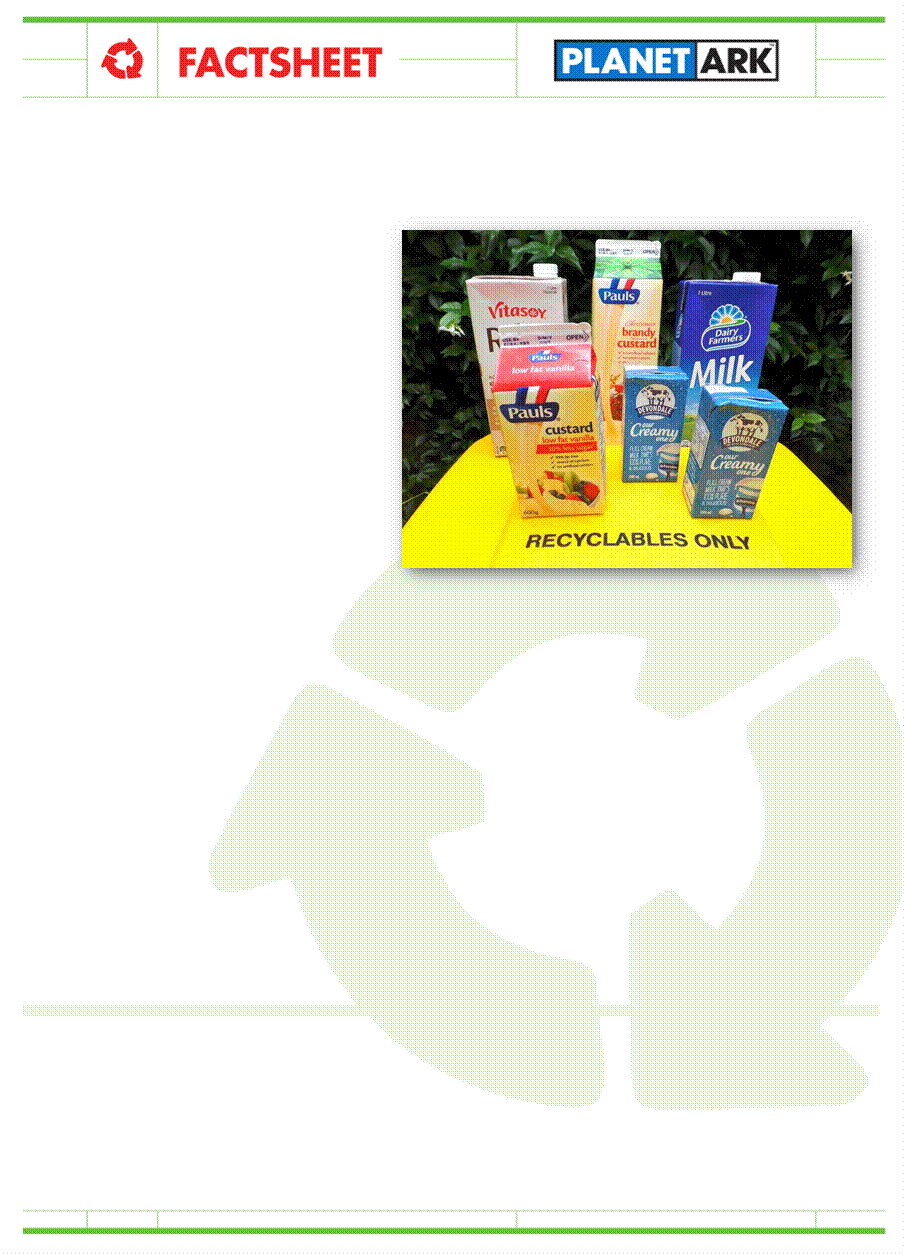
Many people today still don’t realise that beverage cartons are recyclable.
Australians consume more than a billion beverage cartons a year – that’s roughly over 75,000 tonnes of cartons, the equivalent weight of a whopping 535 blue whales! Yet many people continue to put their cartons in their waste bins because they don’t realise cartons are recyclable.
More than 80% of people in Australia live in local councils that collect milk and juice cartons for recycling.
Currently, about 2 in 5 cartons get recycled – Planet Ark wants to encourage more people to recycle used cartons.
Different Types of Cartons
Milk and juice are not the only type of products packaged in cartons. Custard, broth, cream, coconut water and even tomatoes can be found packaged in cartons in your grocery store, on the shelves or in the refrigerated sections — and they’re all recyclable!
Cartons are primarily made of paper, a renewable resource, with thin layers of polyethylene (plastic) and for shelf-stable cartons (also known as Ultra High Temerature, UHT or long-life packs), a thin layer of aluminium. These layers help to keep products fresher for longer, resulting in savings in energy, storage and transport.
Why Recycle
· Reducing green house gases. When the paper inside cartons breaks down in landfill it creates methane, a greenhouse gas with a global warming capacity over 21 times more powerful than carbon dioxide.
· Reducing waste. Used cartons are not waste – they are fully recyclable and serve as valuable secondary resources. The most important thing with cartons, being made from recyclable and valuable resources, is that they don’t end up in landfill.
· Recovering resources. Recycling a kilo of paper can prevent up to a kilo of greenhouse gases from being released. High quality paper fibres in cartons are recycled into new products, including tissues, writing paper, and cardboard.
·
 Saving
water and energy.
Manufacturing paper products from recycled material, rather than virgin reduces
the need to extract raw
materials like fibre, reduces
water use (up
to 99%
less), reduces
energy use
(up to
50% less)
and minimises
chemical use (by up to 90%).
Saving
water and energy.
Manufacturing paper products from recycled material, rather than virgin reduces
the need to extract raw
materials like fibre, reduces
water use (up
to 99%
less), reduces
energy use
(up to
50% less)
and minimises
chemical use (by up to 90%).
What Happens to the Cartons?
Recycling trucks collect kerbside recyclables and take them to Material Recovery Facilities (MRFs). At MRFs, cartons are separated from other recyclable materials and sorted into mixed paper bales. These bales are then packed together and sent to paper mills for recycling.
At the paper mill, cartons are added to a large machine called a Hydrapulper – essentially a giant blender – that uses water to break the cartons down into two component parts. The paper is separated and the pulp is used to make a variety of paper products, such as paper towels, tissue, paper bags, etc. The plastic and aluminium together can be sent on for further recycling, such as to produce roofing tiles or wallboards, or can be used for energy to fuel the paper mill.
Dedicated carton recycling facilities (more than 150 worldwide) can recycle cartons into even more products. Used cartons are turned into envelopes, plasterboard liner, paper carrier bags, broom handles, roof tiles and even furniture!
Take Action
· Visit RecyclingNearYou.com.au for information about council services and drop-off locations for cartons in your local area.
· Rinse and flatten cartons before placing in your kerbside collection. This helps to keep away pests and odour, as well as saves space in your bin.
· A 10 cent refund is available through state-based Container Deposit Schemes (CDS) for favoured milk and juice cartons under 1 litre. CDS are already running in SA and NT, with the NSW ‘Return and Earn’ scheme starting on December 1, 2017, and in QLD and WA in 2018 and 2019 respectively.
More Information