NETWASTE REGIONAL WASTE AND SUSTAINABLE MATERIALS STRATEGY 2023-2027 - funded by NSW Environment Protection Authority Establish a waste management model that ensures cost effective environmental best practice for participating NetWaste Councils, develops effective educational strategies that support this model, and undertakes ongoing projects as identified as part of the waste management planning process.

|
DOCUMENT CONTROL |
||||||
|
Version |
Description |
Date |
Author |
Reviewer |
Approver |
|
|
0.5 |
Early Draft |
22/12/2022 |
LC |
JB |
JB |
|
|
1.0 |
Draft |
8/2/2023 |
JB |
LC |
JB |
|
|
2.0 |
Final Draft |
2/3/2023 |
JB |
JB/LC |
JB |
|
|
3.0 |
Final Copy |
10/3/2023 |
JB |
ACW |
JB |
|
|
4.0 |
Final Report - Draft |
14/3/2023 |
JB |
ACW |
JB |
|
|
5.0 |
Final Report |
17/3/2023 |
JB |
|
JB |
|
|
Approval for Release |
||||||
|
Name |
Position |
File Reference |
||||
|
Jonathan Beckett |
Principal Waste Consultant |
TW22135_NetWaste_Regional Waste and Sustainable Material Strategy 2023-2027_5.0 |
||||
|
Signature |
DN: O=Talis Consultants, CN=Jonathan Beckett, Reason: I am approving this document Beckett Location: Hamilton, NSW Date: 2023-03-17 10:26:04 Foxit PhantomPDF Version: 10.0.1 |
|||||
|
Copyright of this document or any part of this document remains with Talis Consultants Pty Ltd and cannot be used, transferred, or reproduced in any manner or form without prior written consent from Talis Consultants Pty Ltd. |
||||||


Acknowledgement
Preparation of this Strategy has been funded and supported by the NSW Environment Protection Authority through the Waste and Sustainable Materials Strategy 2041.
Information contained in this publication is based on knowledge and understanding at the time of writing (January 2023) and is subject to change.
Acknowledgement of
Country
NetWaste acknowledges the traditional custodians of the land and pays respect to Elders past, present and future.
We recognise Australian Aboriginal and Torres Strait Islander peoples’ unique cultural and spiritual
relationships to place and their rich contribution to society.
Table of Contents
1 TOC \o "1-3" \h \z \u About NetWaste................................................................................... 10
1.1 Charter......................................................................................... 10
1.2 Aim.............................................................................................. 10
1.3 Function....................................................................................... 10
1.4 Member Councils.......................................................................... 11
1.5 Region......................................................................................... 11
2 Introduction..................................................................................... 13
2.1 Statement of Document Purpose................................................... 13
2.2 Stages of Strategy Development................................................... 13
2.3 Strategy Delivery.......................................................................... 13
2.4 Project Deliverables...................................................................... 14
2.5 Stakeholder Engagement.............................................................. 14
2.6 Source of Data for the Strategy..................................................... 14
3 Drivers for Change......................................................................... 16
3.1 Summary of Policy....................................................................... 16
3.1.1 Joint Procurement (sustainable procurement)...................... 16
3.1.2 Strategic Infrastructure, Planning, and Investment............... 17
3.1.3 Avoid Generation of Waste................................................. 17
3.1.4 Community Waste Awareness and Education Programs...... 17
3.1.5 Circular Economy (CE)....................................................... 17
3.1.6 Better Waste Management and Resource Recovery............ 18
3.1.7 Better Hazardous Waste Management................................ 18
3.1.8 Divert Organics from Landfill.............................................. 18
3.1.9 Reduce Litter..................................................................... 18
3.1.10 Avoid Plastic Waste........................................................... 18
3.1.11 Reduce Illegal Dumping and Waste Crime.......................... 19
3.1.12 Develop Energy from Waste............................................... 19
3.2 Policy Frameworks................................................................. 19
3.2.1 National Framework........................................................... 19
3.2.2 State Framework............................................................... 19
3.2.3 Regional Framework.......................................................... 21
3.2.4 Local Framework............................................................... 22
3.3 Guiding Principles................................................................. 23
3.3.1 Circular Economy.............................................................. 23
3.3.2 Waste Hierarchy................................................................ 24
3.3.3 Net Zero Emissions............................................................ 25
3.3.4 Sustainable Procurement.................................................... 26
4 NetWaste Current Strategic Direction........................................ 27
4.1 NetWaste Governance and Structure...................................... 27
4.2 NetWaste Strategic Direction................................................... 27
4.2.1 Strategic Recycling Plan................................................ .... 27
4.2.2 NetWaste Member Council Response to Draft WaSMS....... 28
4.2.3 Waste Aggregation Profile................................................. 29
4.2.4 Regional Education Plan..................................................... 32

5 Where are we now?............................................................................................................ 33
5.1 Regional Profile............................................................................ 33
5.1.1 Waste Managed by Member Councils................................. 33
5.1.2 Waste Diverted from Landfill.............................................. 35
5.1.3 Regional SWOT Analysis................................................... 36
5.2 Current Waste Management Services and Infrastructure................ 37
5.2.1 Kerbside Waste Management Services............................... 37
5.2.2 NetWaste Member Waste Infrastructure............................. 39
5.2.3 Private Sector Waste Infrastructure.................................... 44
5.3 Waste Generation Projections....................................................... 45
5.3.1 Waste Projections.............................................................. 45
5.4 Regional Contracts....................................................................... 48
5.5 Regional Initiatives........................................................................ 49
5.6 Previous Achievements................................................................. 50
5.6.1 Engagement...................................................................... 50
5.6.2 Waste Operations, Infrastructure and Services................... 51
5.6.3 Problem Wastes................................................................. 51
5.6.4 Resource Recovery........................................................... 51
5.6.5 Litter and Illegal Dumping................................................... 51
5.7 Regional Issues and Challenges................................................... 51
5.7.1 Issues............................................................................... 52
5.7.2 Challenges........................................................................ 55
6 Where do we want to get to?.............................................................. 58
6.1 Strategic Vision............................................................................ 58
6.2 Strategic Objectives...................................................................... 58
7 How are we going to get there?.......................................................... 59
7.1 Action Areas................................................................................. 59
7.2 Strategy Delivery.......................................................................... 62
7.2.1 Strategy Action Plan.......................................................... 62
7.2.2 Strategy Delivery Partners................................................. 63
7.2.3 Strategy Resourcing.......................................................... 63
7.2.4 Sub-Regional Zones........................................................... 63
Tables
Table 5-4 - Member Council Kerbside Collection Services (FY22/23)............. 38
Table 5-5 – Member Council Waste and Resource Recovery Infrastructure.... 40
Table 5-8 – Details of Participation within Regional Contracts........................ 48
Table 5-9 - NetWaste Regional Initiatives..................................................... 49
Figures
Appendices
APPENDIX A Stakeholder Engagement APPENDIX B Policy Context APPENDIX C Regional Contracts APPENDIX D Strategy Action Plan
Acronyms Used
|
Abbreviation |
Full Form |
|
CCMAP |
Climate Change Mitigation and Adaptation Plan |
|
C&D |
Construction and Demolition (Waste) |
|
CDS |
Container Deposit Scheme |
|
C&I |
Commercial and Industrial (Waste) |
|
CRC |
Community Recycling Centre |
|
CSP |
Community Strategic Plan |
|
DWMC |
Domestic Waste Management Charge |
|
EPA |
(NSW) Environment Protection Authority |
|
EPL |
Environment Protection Licence |
|
EfW |
Energy from Waste |
|
FOGO |
(Combined) Food Organics and Garden Organics |
|
GO |
Garden Organics |
|
GHG |
Greenhouse Gas (emissions) |
|
IPART |
Independent Pricing and Regulatory Tribunal |
|
JO |
Joint Organisation (of Councils) |
|
LGA |
Local Government Area |
|
MRF |
Material Recovery Facility |
|
MSW |
Municipal Solid Waste |
|
OLG |
Office of Local Government |
|
PFAS |
Per- and Poly-Fluoroalkyl Substances |
|
RENEW |
Regional Networks for Effective Waste Management |
|
REZ |
Renewable Energy Zone |
|
ROC |
Regional Organisation of Councils |
|
RRC |
Resource Recovery Centre |
|
SAP |
Special Activation Precinct |
|
TPA |
Tonnes Per Annum |
|
VWG |
Voluntary Waste Group |
|
WAPP |
Waste Aggregation Profile Project |
|
WaSMS |
(NSW) Waste and Sustainable Materials Strategy 2041 |
Short Message to the Reader
The terms waste and waste management are used collectively herein to firstly describe all materials originally discarded, and secondly, their fate through various processing pathways such as disposal, recycling, and resource recovery.
This approach simplifies written explanations, using the term residual waste to expressly describe material disposed to landfill or managed by energy from waste (EfW) processes.
This Strategy and Action Plan have been prepared within a responsive and flexible approach to delivering the State’s new Waste and Sustainable Materials Strategy 2041 (WaSMS), focusing on the first five-years of an overall 20-year planning horizon. Its approach aligns with both Stage 1 of the WaSMS and NSW EPA guidance material for development of regional strategies by regional voluntary waste groups (VWG).
1 About NetWaste
NetWaste is a voluntary regional waste group comprised of 25 Member Councils covering almost 40% of the state, stretching from Lithgow in the East, West to Broken Hill, and north up to the Queensland border.
1.1 Charter
The organisation provides a platform for member Councils to collectively pursue regional benefits and improve outcomes related to waste management for its members. This includes facilitating close regional cooperation, operational and kerbside services contracting, resource and knowledge sharing, and cultivating shared investment and planning infrastructure development opportunities.
1.2 Aim
NetWaste’s aim is to establish a waste management model that ensures cost effective environmental best practice for participating NetWaste Councils, develops effective educational strategies that support this model, and undertakes ongoing projects as identified as part of the waste management planning process.
1.3 Function
Formed in 1995, NetWaste is part of the NSW Environment Protection Authority (EPA) funded Regional Networks for Effective Waste Management (RENEW) voluntary groups of Councils. The organisation provides a platform for member Councils to collectively pursue regional benefits and improve outcomes related to waste management.
NetWaste is built upon trust, collaboration and is both adaptive and responsive to change. Traditionally it has provided flexible solutions and support for member Councils within the following core areas:
· Education and awareness – development of a comprehensive Education Strategy delivered by a dedicated Environmental Learning Advisor, providing on-going, positive, and meaningful education initiatives;
· Procurement – provision of a variety of waste collection and processing contract opportunities, providing the benefits of contract administration, economies of scale, improved pricing and an expanded service offering for communities; and
· Knowledge sharing – dissemination of key information on waste-related matters in plain language, including policy updates and compliance-related matters.
NetWaste’s goal is to set the benchmark for regional waste management through a range of strategic objectives, including:
· Reducing the amount of waste generated;
· Increasing resource recovery;
· Reducing greenhouse gas emissions;
· Delivering environmentally responsible waste management systems;
· Improving awareness of waste minimisation and resource recovery principles, and influencing behavioural change;
· Improving recycling and composting;
· Reducing litter and illegal dumping;
· Managing problem wastes;
· Facilitating information exchange and skills development; and
· Optimising procurement of grant funding.
More recently, NetWaste’s scope has evolved to also include advocating for meaningful change to state policy and the regulatory framework on behalf of its members.
1.4 Member Councils
Member Councils wish to express their on-going support for NetWaste, citing it as an invaluable organisation they rely on considerably to deliver their own waste management services. NetWaste’s regional contracting, dissemination of state policy and regulation, information and experience sharing, and its advocacy and leadership, were all reported as significant benefits by members.
1.5 Region
The NetWaste region is spread across 310,000 km2 of New South Wales, encompassing almost 40% of the state (refer figure over). It has an estimated total population of approximately 320,000, including the following member Councils:
|
· Bathurst · Blayney · Bogan · Bourke · Brewarrina · Broken Hill · Cabonne · Central Darling · Cobar |
· Coonamble · Cowra · Dubbo · Forbes · Gilgandra · Lachlan · Lithgow · Midwestern · Narromine |
· Oberon · Orange · Parkes · Walgett · Warren · Warrumbungle · Weddin |
Figure 1-1 - NetWaste Region
2 Introduction
2.1 Statement of Document Purpose
NetWaste’s Regional Waste and Sustainable Materials Strategy 2023-27 (the Strategy) has been developed with a 20-year strategic delivery horizon, with a specific focus on the first five years. It hinges on a responsive, dynamic, and flexible delivery framework to improve waste services delivered and their performance within the region.
The Strategy and its accompanying Action Plan align with the strategic direction of the NSW Waste and Sustainable Materials Strategy 2041- Stage 1: 2021-2027 (WaSMS)1, whilst retaining as much of the social, economic, and skills-based benefits of local transformation of waste as possible.
2.2 Stages of Strategy Development
Development of the Strategy was undertaken within the following primary stages. Information and data supporting their development may be found within the Appendices.
The primary stages are:
· Drivers for Change – A review of key policy in context of delivering positive change in regional waste management outcomes;
· Where are we today? - A review of current regional operations and services;
· Where do we want to get to? – A statement of intended or desired goals and outcomes; and
· How are we going to get there? – Development of the regional strategic direction to deliver positive change.
2.3 Strategy Delivery
The Strategy will be delivered by its supporting Action Plan introduced within Section 7. One of the Plan’s core features is a quarterly review by the NetWaste Steering Committee, who will both describe delivery progress (status) of Actions, and as required, make amendments in light of the prevailing delivery environment.
Each May the Steering Committee will decide if the Plan and Strategy require updating. At this point the Committee will also decide about taking on any additional/replacement Actions from the “medium” and “Low” priority areas of the Action Plan.
Strategy delivery herein is not intimately linked to local government’s Integrated Planning and Reporting (IP+R) framework given the Strategy reflects the voluntary status of NetWaste and its Steering Committee working at a regional level. However, it is hoped member Councils will subsequently develop their own Waste Strategies to support delivery of NetWaste’s Strategy, and commitments made at this level may form part of each Council’s own IP+R commitments/responsibilities.

1 The Strategy complies with the NSW EPA’s guidance document Taking a regional response to the Waste and Sustainable Materials Strategy, February 2022
Ultimately the success of strategy delivery will depend not only on the work of NetWaste’s Steering Committee, but also on building relationships and partnerships within a collaborative regional approach, and importantly, on member Councils preparing their own waste strategies which integrate into a regional approach.
2.4 Project Deliverables
NetWaste will be provided a Strategy document with a supporting Action Plan. The Action Plan will provide details of Actions to be undertaken to deliver desired positive change over an initial 5-year period. Actions will be grouped within Strategic Initiatives, within Action Areas; each Action Area supporting pre-determined Themes and Priority Areas identified by the NSW EPA as necessary to deliver the State’s WaSMS.
It is intended NetWaste’s Executive2 review strategy delivery progress against the Action Plan each quarter, taking steps to correct or improve delivery based on an assessment and feedback mechanism. The Action Plan will similarly be flexible and dynamic in its structure, allowing NetWaste to move around within three nominated priority categories3 over a 20-year delivery period in response to changing industry, market, funding, and political conditions.
2.5 Stakeholder Engagement
The Strategy and its Action Plan were developed within a close working relationship between Talis, the NetWaste Executive and member Councils.
Member Councils were engaged within development of the Strategy at four key touchpoints. These were:
· Request for Information – initial request for LGA-specific data and information;
· On-line sub-regional workshops – discussion and feedback on key issues relevant to each region;
· Face-to face Strategy Development workshop – discussion of prepared draft strategic objectives and group preparation of high level Actions to deliver these; and
· Face-to-face Strategy Delivery Workshop – discussion and feedback of draft Strategy and Action Plan.
Details of each consultation step and outcomes generated are summarised within Appendix A.
2.6 Source of Data for the Strategy
Following consultation with NetWaste following closure of the RFI period, it was agreed that as only 60% of Councils had responded, it would be preferable to instead use FY 19/20 data collected as part of the 2021 regional Waste Aggregation Profile Project (WAPP). This data set was not only complete,
2 Its Projects Coordinator, Executive Officer, and Steering Committee
3 The Action Plan will be structured to include Actions within High Priority (First Five Years 2023-2027), Medium Priority (2028-2032) and Low Priority (2033 onwards to 2041) categories, providing NetWaste with the opportunity to adopt additional or alternative Actions from Medium and Low Priority categories within a flexible, adaptable approach to future environments
but its input and outcomes generated had also been reviewed and approved by individual Councils for their own local government areas (LGAs).
Member Councils confirmed this was still representative of their operations, although could in the future be impacted by either/both ongoing major state infrastructure projects (such as the Inland Rail) and significant regional developments (such as opening up of new mining areas).
3 Drivers for Change
Drivers for Change, or more commonly referred to, drivers for improvement in waste service delivery and operational performance, broadly include the framework of regulations, policies, strategies, and guidelines (Policy) at the local, regional, state, and national level, and a number of waste industry Guiding Principles. They influence and guide the development of new strategy by providing the context in which it needs to be developed and delivered. Their influence is therefore also reflected within the structure and composition of the Strategy’s Action Plan introduced within Section 7.
It is important to recognize that the current Policy environment at both the national and state level is very much in a state of flux, with rapid changes occurring, especially on the climate change front. The full extent of recent changes on the local government sector remains to be seen, but it is generally understood that Councils will shoulder increased responsibilities and costs related to waste management.
Key Policy drivers for change are considered to include:
· National Waste Policy Action Plan (2019);
· NSW CE Policy Statement (2019);
· NSW DPIE Net Zero Plan Stage 1 (2020 – 2030);
· Recycling and Waste Reduction Bill (2020);
· COAG Response Strategy (2020);
· NSW DPIE Waste and Sustainable Materials (WaSM) Strategy (2021 – 2041);
· NSW EPA WaSM Program Funding (2021 onwards);
· NSW DPIE Plastics Action Plan (2021 – 2041);
· NSW DPIE Infrastructure Plan (2021 – 2041);
· NSW EPA Strategic Plan (2021 – 2024);
· NSW EPA Draft Delivery Plan (2021 – 2027); and
· NSW EPA EfW Infrastructure Plan (2021).
A summary of the combined direction of Policy is presented below, whilst a more detailed synopsis is presented within Appendix B.
3.1 Summary of Policy
Key components of Policy assessed as influential for development of new Strategy are summarised below under common subject matter headings.
3.1.1 Joint Procurement (sustainable procurement)
· Adoption of policy to improve recycled content procurement;
· Development of procurement targets for recycled content, including how they will be calculated, achieved, and audited;
· Reporting on progress in achieving procurement targets with recycled content, particularly those which have significantly increased use of recycled materials within infrastructure projects; and
· Facilitate joint council procurement of waste services.
3.1.2 Strategic Infrastructure, Planning, and Investment
· Analysis and reporting of requirements for infrastructure capacity to process paper/cardboard, glass, plastics, and tyres;
· Building industry capacity to collect, recover, recycle, and remanufacture from waste;
· Identification of opportunities to increase uptake of recycled content within development of buildings and infrastructure, in particular plastics, rubber and glass;
· Create new job opportunities associated with new technologies;
· Invest in innovation and innovative processing technologies which lower the cost of renewable energy and/or emissions released (clean technology program); and
· Consider future, new waste streams associated with a low carbon economy, such as batteries and solar panels.
3.1.3 Avoid Generation of Waste
· Support of programs for business and communities to avoid generation of waste and divert waste from landfill, particularly food waste, including community-based “repair” of waste;
· Delivery of targeted programs to businesses to identify and avoid waste generation, and increase efficiency of use of materials and their recovery from waste streams; and
· Reduce total waste per person by 10% by 2030.
3.1.4 Community Waste Awareness and Education Programs
· Use of community education programs to reduce food waste, in particular;
· Improve quality of co-mingled MRF recyclates through a “whole-of-value chain” approach;
and
· Foster behaviour change through education and engagement.
3.1.5 Circular Economy (CE)
· Support and promotion of CE principles – support innovation, sustainable procurement, high quality consistent recycling, value organics, product stewardship, circular design, re-use and repair, and responsible packaging;
· Supporting and promotion of CE principles within businesses;
· Community and industry actively contribute to a CE;
· Leverage government purchasing power to stimulate local CE;
· Design for the multiple uses at the highest value– such as reuse, sharing, remanufacturing and refurbishment as preference to recycling;
· Advocacy to support best-practice CE mechanisms, such as product stewardship and responsible packaging design;
· Development of new markets for recovered, re-processed and re-manufactured commodities;
· Resilient systems and robust markets are available to keep waste materials circulating and to de-carbonise the NSW economy;
· Support reuse of crushed glass, particularly road construction and other civil works;
· Support growth of sustainable markets for high quality, processed organics;
· Support reuse and repair; and
· Explore more effective means to improve data reporting and sharing of information.
3.1.6 Better Waste Management and Resource Recovery
· Leveraging existing regional development programs to support better waste management and resource recovery;
· Achieve 80% average recovery rate for all waste streams by 2030;
· Ensure the harmful impacts of waste are reduced and waste minimised;
· Promote landfill consolidation and environmental improvements plans;
· Support increased supply of higher-grade paper available for recycling (to replace non-recyclable packaging);
· Support higher grade tyre crumbing, tyre-derived fuel, and exploring processing tyre-derived polymers (TDP);
· Investigate landfill options past 2040 (when existing capacity exhausted); and
· Focus on landfill diversion options for problem wastes such as textiles.
3.1.7 Better Hazardous Waste Management
· Better management of end-of-life disposal of products containing hazardous substances.
3.1.8 Divert Organics from Landfill
· Delivery of kerbside FOGO collection for households and businesses;
· Support for organics processing facilities;
· Halve landfilled organic waste by 2030;
· Achieve net zero emissions from organic waste by 2030, including:
o Separate collection of food and garden organics from all NSW households by 2030;
o Separate collection of food waste from businesses that generate highest volumes –
includes large supermarkets and hospitality, by 2025;
· Take action to reduce emissions and mitigate climate change impacts aligned with the principles in the NSW Net Zero Plan 2050;
· Increase uptake of landfill gas capture; and
· Create a carbon negative waste sector.
3.1.9 Reduce Litter
· Reduce overall litter by 60% by 2030 and plastic litter by 30% by 2025; and
· Reduce cigarette butt litter in particular.
3.1.10 Avoid Plastic Waste
· Eliminate single use plastics by 2025;
· Triple plastics recycling rate by 2030; and
· Accelerate transition to better plastic products.
3.1.11 Reduce Illegal Dumping and Waste Crime
· Reduce and prevent Illegal dumping.
3.1.12 Develop Energy from Waste
· Utilise non-combustion technology, particularly that derived from waste feedstock, producing energy on site for industrial and/or manufacturing purposes.
3.2 Policy Frameworks
3.2.1 National Framework
The National Waste Policy – Less Waste, More Resources was released by the Department of the Environment and Energy in 2018 and provides a framework for collective action by businesses, governments, communities, and individuals until 2030. The policy identifies the following seven targets:
· Ban the export of waste plastic, paper, glass, and tyres, commencing in the second half of 2020;
· Reduce total waste generated in Australia by 10% per person by 2030;
· 80% average resource recovery rate from all waste streams following the waste hierarchy by 2030;
· Significantly increase the use of recycled content by governments and industry;
· Phase out problematic and unnecessary plastics by 2025;
· Halve the amount of organic waste sent to landfill by 2030; and
· Make comprehensive, economy-wide, and timely data publicly available to support better consumer, investment, and policy decisions.
3.2.2 State Framework
The NSW government released the WaSMS Stage 1 as the first stage of a 20-year strategy focusing on the environmental benefits and economic opportunities to reduce waste, improve waste management, and increase material recycling.
The WaSM Strategy aims to reduce waste generated and increase recycling through adoption of the Targets outlined in Figure 3-14.
the NSW government has also recently released the NSW Litter Prevention Strategy 2022–30 and the Illegal Dumping Prevention Strategy 2022-27, both of which underpin the WaSMS.
4 Source: NSW Waste and Sustainable Materials Strategy 2041: Stage 1 – 2021-2027
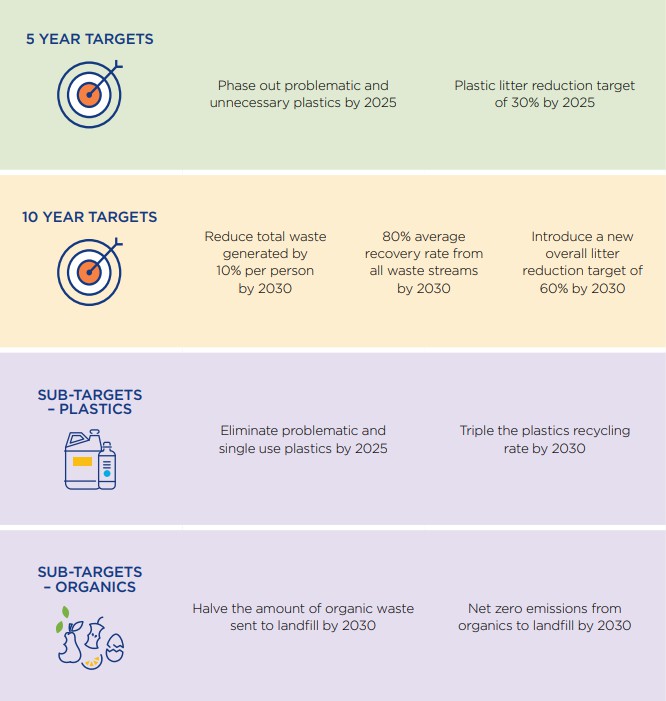
Figure 3-1 - NSW WaSMS Targets
To achieve the WaSMS targets of halving food waste to landfill and achieving net zero emissions from organics in landfill by 2030, the government will require the separate collection of:
· Food and garden organics from all NSW households by 2030; and
· Food waste from businesses that generate the highest volumes, including large supermarkets and hospitality businesses, by 2025.
Based on an assessment of waste and circular economy infrastructure needs over the next decade and beyond, the government has identified three key areas to focus on – residual waste, organics, and plastics. Recovery and recycling infrastructure will need to keep pace with demand and to support this, there will need to be investment in new and upgraded facilities from now to 2030 to prevent any shortfall in capacity.
Getting the right infrastructure in the right place will be critical to recover, reuse and extend the life of most materials. The WaSMS Guide to Future Infrastructure Needs 2021 reviews the waste infrastructure requirements in NSW to underpin this change.
The NSW Government has also released the Energy From Waste (EfW) Infrastructure Plan. The Parkes Special Activation Precinct (SAP) has been identified as one of the priority locations to host a waste from energy facility, along with West Lithgow Precinct, Richmond-Valley Regional Jobs Precinct and Southern Goulburn Mulwaree Precinct.
The NSW Plastics Action Plan supports the WaSM. The NSW Plastics Action Plan will assist in delivering the following targets from the WaSM Strategy:
· Phase out problematic and unnecessary plastics by 2025;
· Reduce the total waste generated by 10% per person by 2030;
· Achieve an average 80% recovery rate of resources from all waste streams by 2030;
· Significantly increase the use of recycled content by government and industry;
· Reduce plastic litter items by 30% by 2025;
· Reduce the overall litter by 60% by 2030; and
· Triple the plastics recycling rate by 2030.
3.2.3 Regional Framework
The EPA funds the collaborative work of voluntary regional waste groups of councils in NSW to deliver regional waste strategies and coordinate regional projects and grants. There are 14 voluntary regional waste management groups across NSW, including NetWaste. These voluntary waste groups are represented by RENEW, whose primary goal is to highlight the differing issues and priorities across the state and implement better waste and resource recovery systems. Through coordinating and combining regional waste groups, RENEW works together to find solutions to waste issues, to improve recycling rates and initiate best practice waste management in NSW.
Regional Organisations of Councils (ROCs), sometimes called Voluntary Regional Organisations of Councils, are voluntary groupings of Councils in Australia and typically involve collaborative partnerships between neighbouring Councils in a particular region or area. Joint Organisations of Councils (JOs) are organisations formed to strengthen collaboration and engagement between State and local governments and improve infrastructure and service delivery to regional communities, with NSW having a network of 13 joint organisations across the state.
The NetWaste region covers four JOs. These organisations are intended to strengthen collaboration and engagement between State and local governments, with the aim of improving infrastructure and service delivery to regional communities. Each JO provides a possible partner for NetWaste to assist with delivery of the Strategy’s Actions. The Councils of Brewarrina, Coonamble and Dubbo stand alone, meaning they are not part of any JO or ROC.
Table 3-1 provides a breakdown of the different JOs and their member Councils within the NetWaste region.
Table 3-1 –NSW Joint Organizations including NetWaste Member Councils
|
Central NSW Joint Organisation (CNSWJO) |
|
|
Bathurst Regional Council |
Lachlan Shire Council |
|
Blayney Shire Council |
Oberon Council |
|
Cabonne Council |
Orange City Council |
|
Cowra Council |
Parkes Shire Council |
|
Forbes Shire Council |
Weddin Shire Council |
|
Lithgow City Council |
|
|
Orana Joint Organisation (OJO) |
|
|
Bogan Shire |
Narromine Shire |
|
Gilgandra Shire |
Warren Shire |
|
Mid-Western Regional |
Warrumbungle Shire |
|
Far South West Joint Organisation (FSWJO) |
|
|
Broken Hill City |
Central Darling Shire |
|
Far North West Joint Organisation (FNWJO) |
|
|
Bourke Shire Council |
Walgett Shire Council |
|
Cobar Shire Council |
|
3.2.4 Local Framework
The Local Government Act 1993 sets out the legal framework, governance, powers, and responsibilities of councils in New South Wales. The Act sets out the functions of Councils, including its service functions such as, providing community health, recreation, education and information services, environmental protection, and waste removal and disposal.
A Community Strategic Plan (CSP) is a key element within the integrated planning and reporting framework which all Councils in NSW have a legislative obligation to adhere to. This framework aims to streamline a council’s operations and optimise the use of resources. The CSP addresses four key questions for the community:
· Where are we now?
· Where do we want to be in ten years’ time?
· How will we get there?
· How will we know when we have arrived?
The implementation of the CSP is supported by a suite of integrated plans that include actions to support the strategies identified in the CSP. These include the following:
· Delivery program – a 4-year plan that sets out the strategies from the CSP that will be priorities for the current council term;
· Operational plan – an annual plan containing detailed actions from the Delivery program; and
· Resourcing strategy – a suite of key plans that support the implementation of the CSP, focusing on finances, workforce, and asset management.
Sustainable waste services are commonly included as a high-level entry within the Environment sections, or similar, within the regional CSPs.
JOs have a requirement for their own regional delivery plans, or Statement of Strategic Regional Priorities (SSRP). Not surprisingly, there exists common areas of interest between NetWaste’s new Strategy and SSRPs of JOs within the NetWaste region, which together will hopefully strengthen
NetWaste’s regional approach (for example, support for a regional circular economy, preparation of emissions reduction plans, and sustainable management of climate change).
Member Councils are in various stages of having a Waste and Resource Recovery Strategy/Plan outlining the strategic and operational direction for waste management within their Council. Where possible, these framework documents for each member Council were considered and utilised to inform and support the development of this regional Strategy.
3.3 Guiding Principles
The guiding principles presented below provide the basis for driving improved change within the waste management and resource recovery industry. The principles influence the approaches to facilitate greater diversion of waste from landfill, guide better practices and improve performance. The principles include the internationally recognised circular economy, waste hierarchy, along with state-based initiatives of net zero emissions and sustainable procurement. These principles form the basis upon which the Strategy has been developed.
3.3.1 Circular Economy
 NSW
is transitioning to a circular economy over the next 20 years. A circular
economy aims to 'close the loop
on waste'
by minimising
what we throw
away, and using
and reusing
our resources efficiently, making them as productive as possible. It
is an alternative to the traditional linear economy (take, make, use,
dispose), which refers to taking resources, making goods that are then
bought and used to then be disposed of as waste, as shown in
Figure 3-2.
NSW
is transitioning to a circular economy over the next 20 years. A circular
economy aims to 'close the loop
on waste'
by minimising
what we throw
away, and using
and reusing
our resources efficiently, making them as productive as possible. It
is an alternative to the traditional linear economy (take, make, use,
dispose), which refers to taking resources, making goods that are then
bought and used to then be disposed of as waste, as shown in
Figure 3-2.
The NSW Circular Economy Policy Statement (NSW EPA, 2019) guides the ambition and approach to a circular economy and establishes
seven principles to maximise the use and value of resources including:
· Sustainable management of all resources;
· Valuing resource productivity;
· Design out waste and pollution;
· Maintain the value of products and materials;
· Innovate new solutions for resource efficiency;
· Create new circular economy jobs; and
· Foster behaviour change through education and engagement.
Benefits of implementing a circular economy concept include job creation, reduction in carbon emissions and improved resource efficiency.
3.3.2 Waste Hierarchy
The waste management hierarchy is an internationally adopted principle and concept which lists waste management options in order of preference according to their sustainability and environmental impacts.
 The
hierarchy has been adopted within the Strategy as the basis for classifying
and assessing the various resource recovery options which are being
considered to assist NetWaste to improve waste management across the region.
The
hierarchy has been adopted within the Strategy as the basis for classifying
and assessing the various resource recovery options which are being
considered to assist NetWaste to improve waste management across the region.
As shown in
Figure 3-3, options which achieve outcomes higher up the hierarchy are preferred over those located further down the hierarchy.

3.3.3 Net Zero Emissions
Climate change is affecting communities across Australia and across the globe. The NSW Government's Net Zero Plan Stage 1: 2020-2030 is the foundation for the State's action on climate change and its goal to reach net zero emissions by 2050. It outlines the NSW Government’s plan to act and protect our future in collaboration with industry, communities, and households. Delivery of the Plan is aimed at growing the economy, creating jobs, and reducing emissions to ensure NSW is well placed to prosper in a low carbon world.
The Plan aims to deliver a 50% cut in emissions by 2030 compared to 2005 levels as the first stage to achieving net zero emissions by 2050. By reducing emissions, local Councils can help to increase the resilience of their communities and act as a catalyst for NSW to meet its net zero emissions goals. Supporting this Plan is the draft Climate Change Policy and its companion document, the draft Climate Change Action Plan 2022–25, which sets out the roadmap for how NSW will achieve net zero.
NSW Councils have a key role in the shift to net zero emissions as leaders, place makers and through their connection to local communities. Local Councils can support the transition through reducing
their own emissions across their operations and through the provision of essential services such as waste management, transport, planning and infrastructure for their residents and businesses.
Under the Climate Change Action Plan, Councils holding an environmental protection licence will be required to prepare climate change mitigation and adaptation plans (CCMAPs) and report on the effectiveness of their plans over time. The timing for the development and submission of these plans is to be determined.
3.3.4 Sustainable Procurement
Sustainable procurement takes into consideration the economic, environmental, social and governance impacts of any purchase with the four factors referred to as the quadruple bottom line and relate to a total purchase cost, and not just the upfront dollar expense.5
In terms of sustainable procurement practices, the following emphasise the entire life cycle of the product or service:
· Devising strategies that reduce demand and extend the life of the product;
· Planning what happens with a product at the end of the contract i.e., how will it be reused, recycled, treated, or disposed;
· Considering costs over the life of the product or service and policies in the planning process;
· Encouraging sustainable solutions and innovation in tenders; and
· Measuring and improving sustainability throughout the life of the procurement.
Approaching procurement sustainably allows Councils and the waste management and resource recovery industry to meet economic, environmental, social and governance requirements, while improving opportunities for a more circular system across the entire supply chain.
5 LGNSW, Sustainable Procurement Guide
4 NetWaste Current Strategic Direction
Councils within the NetWaste region vary greatly in terms of area, population served and remoteness. All of these factors influence the types of waste services provided to communities, as well as the ability of each Council to fund waste services.
4.1 NetWaste Governance and Structure
NetWaste’s governance structure includes a Projects Coordinator (1 FTE), NetWaste Projects Support (0.4 FTE), NetWaste Administration (0.4 FTE), and a NetWaste Environmental Learning Advisor (1 FTE). All staff members are consumed by current workloads, already requiring additional resourcing to deliver key programs and projects.
All positions are dependent on annual funding from the NSW EPA, through the Waste Less, Recycle More initiative. For 2021/2022FY, NetWaste received a total of $504,000 in funding.
Critically, going forward NetWaste will require additional human and financial resources to deliver quantum gains or benefits within the new regional Strategy.
4.2 NetWaste Strategic Direction
Given the shift in focus to a more sustainable approach to managing waste and the key role the waste sector can play in the circular economy, NetWaste has been actively working on progressing waste management outcomes for its member Councils, aligning its strategic direction to this shift.
This Strategy builds upon recent strategic work undertaken by NetWaste. Key documents which have developed this position include:
· Regional Waste Strategy 2017-2021;
· Strategic Recycling Plan and Addendum 1 2018-2023
· NetWaste member Council Response to Draft WaSMS 2020;
· Regional Waste Aggregation Profile 2021; and
· Regional Education Plan 2022-2027.
4.2.1 Strategic Recycling Plan
NetWaste prepared a Strategic Recycling Plan in October 2018 to strengthen its economic resilience and underpin continued sustainable delivery of its regional dry recycling programs in response to China’s National Sword policy. Subsequent to this plan being developed, there were significant changes to the national recycling framework, with the circular economy very much a focus of the government.
In response to a subsequent shift in policy, strategy, legislation, and grant funding available in response to the crisis, the NetWaste Strategic Recycling Plan was updated in November 2020 via Addendum 1. The update focused on a review of dry recycling and updating of the Strategic Recycling Action Plan. Key action areas of the updated action plan were:
· Increase regional independence and resilience;
· Develop processing and markets within a regional circular economy;
· Ensure financial viability of recycling services; and
· Increase dry recycling yield and quality.
4.2.2 NetWaste Member Council Response to Draft WaSMS
In May 2020, NetWaste provided feedback to the NSW Government on its 20-year Waste Strategy Issues Paper. A summary of the feedback provided by NetWaste is provided below.
· Development of regional processing is key to increased diversion from landfill;
· It is essential the State recognises and understands the very significant role Local Government plays in waste management, resource recovery and recycling, and that the upcoming Strategy must support and develop this in consideration of regional feedback (such as that provided by NetWaste);
· The Federal and State Government’s must demonstrate leadership for Local Government to
be effective in increasing recycling;
· Waste management and recycling is a shared responsibility of Local Government with the State;
· Regional waste management and metropolitan waste services provided by Local Government are poles apart;
· Regional Waste Groups are essential to delivery of new State strategy and improvement in regional recycling;
· Funding is vital to deliver significant improvements in recycling at a regional level, which in turn supports circular economy principles, more jobs, and a stronger, more productive regional economy;
· NetWaste is supportive of regional waste-to-energy plants, to divert waste from landfill, retain valuable landfill space for future generations, manage waste where simply unsustainable to deliver new recycling initiatives, and utilise residual calorific value within waste;
· NetWaste is a large and diverse region with widely varying sizes and capabilities of its member Councils, relying heavily on regional information sharing, procurement, and action plans;
· The NetWaste region is collaborative and adaptive to change;
· Initiation of an EPA Liaison Officer/Development Officer to support regional funding delivery and regulatory communication in the future would be of great benefit to NetWaste Councils;
· NetWaste Councils do not support introduction of a Waste Levy, but do support application of a Levy onto manufacturers of products with end-of life disposal costs, in many cases worn by NetWaste Councils;
· Within Direction 1 (Generate Less Waste), increasing extended producer responsibilities, using waste education to minimise purchase of single-use items and/or packaging (particularly complex packaging), and prioritise Product Stewardship (such as high-volume agricultural waste), are the 3 most supported Actions by a modest 50-60% of member Councils;
· Within Direction 2 (Improve Collection and Sorting), standardising kerbside collection systems (to simplify and lower cost of education, before increasing reuse markets), increasing networks for management of problem wastes (low population and isolated communities would benefit more than providing a kerbside service at significant additional expense) and incentivising businesses to recycle more (C+I waste remains the lowest
recycled waste stream for NetWaste Councils and anecdotally, many NSW regional and rural Councils, whilst more pressure could be applied for waste sorting as DA conditions and the construction industry would benefit from its own audit/education to increase recycling), were the 3 most supported Actions, each by a modest 50-60% of member Councils;
· Within Direction 3 (Plan for Infrastructure), development of regional recycling hubs was highly supported by almost 90% of member Councils, and was similarly supported as the highest rated “ideal waste challenge which could be overcome by funding”, with transport subsidies and provision of greater business incentives for investment in regional infrastructure modestly supported by 60% of member Councils; and
· Within Direction 4 (Create End Markets), Greater influence by Government in procurement policy, grant funding to support regional initiatives (although to be much less onerous) and reduction of imported recycled materials were supported modestly by the group at 45-60% of member Councils.
4.2.3 Waste Aggregation Profile
To support improved waste management outcomes, NetWaste commissioned a consultant in 2021 to prepare a Waste Aggregation Profile (WAP) to bring together data from its member Councils waste and resource recovery programs.
The project involved three stages, as follows:
· Stage 1 - identified waste received, processed and its management for each of the member Councils using FY2020 NSW EPA reporting data provided by each Council;
· Stage 2 - surveyed Waste Officer responses regarding concepts such as development opportunities within the region and perceived strengths, weaknesses, opportunities, and threats associated with current services; and
· Stage 3 – involved a series of workshop sessions of Councils within a sub-regional approach, testing the needs and approach by each to the possible future role of NetWaste.
The project resulted in the creation of a regional waste profile, with the overarching general recommendation being that NetWaste develop future strategy, programs, and services with sub-regional zones to better target varying needs and requirements of Councils across the region.
Recommendations from the WAP Project for NetWaste and its member Councils are included below:
NetWaste Strategy Development and Delivery
· Provide stakeholder engagement within member Councils to support NetWaste strategy, programs and services developed;
· Use WAP Report Recommendations to advise development of next RWS strategic initiatives and harness opportunities delivered by the 20YWS, focusing particularly on greater kerbside yields, improving site security and site supervision within the region, and sorting self-haul waste;
· Request additional funding from the NSW EPA to deliver new, targeted programs and services, and explore human resourcing options to deliver these;
· Evaluate Council-contribution funding models to deliver more targeted, sophisticated services and programs if additional government funding is not forthcoming;
· Closely monitor greater Sydney’s requirements for waste disposal, WtE and waste processing as populations increase over the next 20 years, considering possible
infrastructure development within the NetWaste region to increase its resilience, self-reliance, and income;
· Seek and provide member Councils with regular updates of the impacts governments’ combined initiatives to develop onshore sorting and processing are having in NSW, particularly in regard to prices paid for recyclates and prices charged for kerbside processing;
· Make representation to government for transport subsidies to support the feasibility of recycling within isolated parts of the region;
· Evaluate the risk and business case for expanding operations of the NetWaste region’s
Council-owned MRFs;
· Explore options for sub-regional infrastructure asset sharing as a mechanism to decrease operational, environmental, and financial risk;
· Develop/Deliver further waste awareness and education modules, at least focussing on greater separation of waste streams at the kerbside and within self-haul waste, able to be variously used by all member Councils according to their local services, programs and needs; and
· Develop policy templates for member Councils to assist development of local circular economies, such as Purchasing Policy.
NetWaste Service Delivery
· Maintain existing services and programs, which are unanimously supported, appreciated, and considered of great benefit by member Councils;
· Encourage increased sharing of experience, skills, and consulting services between member Councils; and
· Adopt a sub-regional zone approach to tailor programs and services according to the distinct needs of Councils within these zones, also considering options for additional funding to deliver more targeted services should government financial support not be forthcoming.
NetWaste Programs
Waste Disposal
· Review the region’s requirements for waste disposal over the next 40 years, at least considering landfill availability/development and innovative technology options (such as WtE);
· Continue to plan for closure of higher-risk and/or near-capacity landfills, focussing on developing centrally located, higher engineered sites with security and supervisory control; and
· Councils make themselves aware of future regional development projects and the impact these will have on both remaining landfill capacity and opportunities to develop circular economy programs.
Site Management
· Review the relative benefits of Council-provided/managed services in comparison to those provided by contractors, giving member Councils some point of reference to evaluate the relative cost and performance of these services within their individual LGAs; and
· Deliver increased security and supervision of waste sites, restricting access and better recording waste streams received.
Site Operations
· Provide operational and site risk assessment, mitigation and regulatory compliance services for Councils requesting assistance; and
· Review options for on-site sorting of self-haul waste to increase resource recovery, development of a regional circular economy and increase the remaining useful life of landfill assets.
Improved Resource Recovery and Recycling
· Evaluate provision of additional kerbside organics collection and regional processing;
· Evaluate sorting self-haul waste on sites;
· Improve kerbside yields of dry recycling and FOGO to at least rest of state, preferably higher; and
· Aid with delivery of new infrastructure improvements, including grant applications and funding acquittal.
Fees and Charges
· Review regional fees and charges for receival of waste and options to manage between-LGA movement of non-domestic waste, at least ensuring these meet whole-of-life (WoL) expenses and are fairly apportioned between domestic and non-domestic waste received.
Waste and Recycling Data
· Make representation to the NSW EPA to over-haul reporting of waste data into a form which is neither onerous nor repetitive, and which encourages the proactive use of data in strategic decision making and monitoring performance of new initiatives;
· Continually build on the WAP data base and its functionality, re-running new calculations as required and updating with current data as it becomes available;
· Consider options for a more centralised recording of waste data and reporting, encouraging more pro-active use of data in assessments of service delivery;
· Generally, increase granularity of waste data collected by reviewing options for improved volume-to-weight conversion factors and greater detail of waste streams received; and
· Audit waste streams to quantify and qualify calculated diversion from landfill/resource recovery estimates.
Regional Circular Economy
· Make representation to government for additional funding to support the development, launch and at least early-stage functioning of a regional circular economy;
· Develop a Regional Circular Economy Development Plan with input from a regional task force; and
· Evaluate linked regional waste receival and reuse data platforms to support and encourage growth of a regional circular economy.
4.2.4 Regional Education Plan
NetWaste retained a consultant to develop a regional education plan in 2022. The plan, titled Our Backyard. Our Stuff. Our Responsibility. Education Strategy 2022 – 2027 expands on, extends, and refines the actions, approaches, and energies of the former waste education strategy. It considers the evolving context of waste management and community attitudes, capacities, and expectations, and offers innovative and non-traditional approaches to education and engagement. The plan contains specific, strategic NetWaste education and engagement actions for the next five years.
The plan was developed after extensive consultation and research, recognizing the communities across the region are diverse and there is a need to consider the differences within and between communities and that a one size fits all approach is not appropriate. Developing the plan involved getting a clear picture of what has gone before and what’s happening now in order to create a new benchmark about what people are doing, what they know, what they need, and what moves them.
Moving forward and building on its accomplishments, NetWaste will continue to educate, support, facilitate and advocate on behalf of all member Councils to allow them to meet the community’s expectations and enable them to respond to a changing legislative environment in a flexible manner.
5 Where are we now?
5.1 Regional Profile
The diversity in size, budgets, and waste management practices of Councils within NetWaste presents challenges for both development of region-wide programs of equal benefit to all and ability of smaller Councils to deliver positive change.
Waste management services and practices vary greatly within the region. Larger, more densely populated Councils in the east tend to provide a more fulsome range of waste services, with dedicated staff resources to plan and deliver these services. More western Councils typically have much lower populations and are much larger geographically, with waste management responsibilities at these Council’s often shared by Officers with a wide range of other responsibilities.
All waste data is sourced from the Waste Aggregation Profile Project data set.
5.1.1 Waste Managed by Member Councils
Table 5-1 provides an overview of some of the key metrics of the different member Councils in the NetWaste region. In particular, these provide an indication of the population, area, and population density differences between the member Councils.
Table 5-1 – Overview of Member Councils
|
Member Council |
Area (km2) |
Population (Number) |
Population Density (Head/km2) |
Households (Number) |
Median Age (Years) |
Median Wage ($/Year) |
|
WAP Sub-Regional Zone 1 |
||||||
|
Bathurst Regional Council |
3,818 |
43,653 |
11.43 |
15,942 |
38.3 |
51,713 |
|
Dubbo Regional Council |
7,535 |
55,518 |
7.37 |
19,279 |
36.2 |
50,967 |
|
Orange Council |
284 |
43,736 |
153.88 |
16,183 |
36.7 |
53,210 |
|
WAP Sub-Regional Zone 2 |
||||||
|
Blayney Council |
1,525 |
7,508 |
4.92 |
2,763 |
42.7 |
48,593 |
|
Cowra Council |
2,809 |
12,753 |
4.54 |
5,081 |
46.9 |
41,888 |
|
Cabonne Council |
6,022 |
13,760 |
2.28 |
4,913 |
43.7 |
46,486 |
|
Forbes Council |
4,710 |
9,383 |
1.99 |
3,563 |
41.7 |
45,221 |
|
Gilgandra Council |
4,832 |
4,319 |
0.89 |
1,598 |
46.4 |
37,516 |
|
Lithgow Council |
4,512 |
20,854 |
4.62 |
10,238 |
46.2 |
48,138 |
|
Mid-Western Regional Council |
8,752 |
25,704 |
2.94 |
9,638 |
41.6 |
47,928 |
|
Narromine Council |
5,262 |
6,448 |
1.23 |
2,221 |
40.3 |
43,436 |
|
Oberon Council |
3,625 |
5,664 |
1.56 |
2,038 |
46.8 |
49,086 |
|
Parkes Council |
5,958 |
14,453 |
2.43 |
5,401 |
40.3 |
45,044 |
|
Warrumbungle Council |
12,372 |
9,254 |
0.748 |
3,400 |
49.9 |
37,093 |
|
Weddin Council |
3,415 |
35,89 |
1.05 |
1,500 |
51.3 |
37,236 |
|
WAP Sub-Regional Zone 3 |
||||||
|
Brewarrina Council |
19,162 |
1,488 |
0.08 |
473 |
39.1 |
47,151 |
|
Bogan Council |
14,600 |
2,481 |
0.17 |
923 |
39.9 |
46,304 |
|
Bourke Council |
41,598 |
2,417 |
0.06 |
774 |
36.3 |
54,440 |
|
Broken Hill Council |
170 |
17,661 |
103.82 |
7,308 |
43.3 |
52,921 |
|
Central Darling Council |
53,492 |
1,760 |
0.03 |
591 |
42.3 |
44,778 |
|
Cobar Council |
45,575 |
4,098 |
0.09 |
1,409 |
36.9 |
- |
|
Coonamble Council |
9,916 |
3,834 |
0.39 |
1,303 |
38.8 |
40,111 |
|
Lachlan Council |
14,968 |
6,149 |
0.41 |
2,191 |
40.8 |
- |
|
Walgett Council |
22,308 |
5,590 |
0.25 |
1,660 |
44.1 |
37,949 |
|
Warren Council |
10,754 |
2,586 |
0.24 |
936 |
46.6 |
42,600 |
This table highlights the differences in population and its density, which significantly impacts each Council’s budget size and area over which infrastructure and services are provided. Generally, the further west, the greater resourcing issues faced by Council’s and their Officers.
Table 5-2 outlines total municipal solid waste (MSW), commercial and industrial waste (C&I) and construction and demolition waste (C&D) managed by each member Council within the NetWaste sub-regional areas introduced within the WAP project.
Table 5-2 – Waste Managed by Member Councils
|
Member Council |
Waste Managed6 (tonnes, FY19/20) |
||
|
MSW |
C & I |
C & D |
|
|
Sub-regional Zone 1 |
|||
|
Bathurst Regional Council |
24,643 |
18,491 |
8,051 |
|
Dubbo Regional Council |
26,491 |
29,549 |
40,418 |
|
Orange Council |
41,993 |
16,696 |
8,312 |
|
Zone 1 Totals |
88,542 |
64,736 |
56,781 |
|
Sub-regional Zone 2 |
|||
|
Blayney Council |
4,073 |
1,558 |
721 |
|
Cowra Council |
18,560 |
1,068 |
2,874 |
|
Cabonne Council |
8,502 |
152 |
6 |
|
Forbes Council |
15,629 |
858 |
9,996 |
|
Gilgandra Council |
3,097 |
92 |
359 |
|
Lithgow Council |
23,044 |
8,314 |
24,528 |
|
Mid-Western Regional Council |
19,741 |
8,866 |
3,541 |
|
Narromine Council |
10,426 |
3,887 |
11 |
6 Represents the combined total tonnages collected by both Council and contractor operations, and processed/managed both inside and outside the LGA
|
Oberon Council |
2,317 |
2,368 |
2,836 |
|
Parkes Council |
12,926 |
713 |
13,923 |
|
Warrumbungle Council |
4,236 |
444 |
0 |
|
Weddin Council |
1,841 |
903 |
1,702 |
|
Zone 2 Totals |
124,060 |
29,223 |
60,497 |
|
Sub-regional Zone 3 |
|||
|
Brewarrina Council |
1,143 |
922 |
0 |
|
Bogan Council |
2,348 |
88 |
23 |
|
Bourke Council |
2,158 |
342 |
41 |
|
Broken Hill Council |
15,416 |
3,446 |
52,446 |
|
Central Darling Council |
2,085 |
15 |
20 |
|
Cobar Council |
1,225 |
1,475 |
97 |
|
Coonamble Council |
3,532 |
1,292 |
140 |
|
Lachlan Council |
7,388 |
916 |
520 |
|
Walgett Council |
4,425 |
2,583 |
1,945 |
|
Warren Council |
4,006 |
669 |
423 |
|
Zone 3 Totals |
43,726 |
11,748 |
55,655 |
|
Waste Stream Totals |
256,3287 |
105,707 |
172,933 |
|
Total NetWaste All Steams |
534,968 |
|
|
MSW contributes 46% of all waste managed by local government within the NetWaste region. This presents opportunity for gains through more extensive awareness and education programs. C&D waste is generally managed by member Councils themselves, with opportunity for greater diversion through processing to higher market specifications.
5.1.2 Waste Diverted from Landfill
Table 5-3 shows the diversion rate of waste from landfill for each Member Council8. As can be seen, there is a significant range in diversion rates achieved, with the highest being 66% and the lowest being 0%, with an overall weighted9 regional average of 39%.
Table 5-3 – Member Council’s Diversion Rates (FY19/20)
|
Member Council |
Diversion Rate (%) |
|
Sub-regional Zone 1 |
|
|
Bathurst Regional Council |
28 |
|
Dubbo Regional Council |
35 |
|
Orange Council |
53 |
|
Zone 1 Numerical Average |
39 |
|
Sub-regional Zone 2 |
|
|
Blayney Council |
18 |
|
Cowra Council |
56 |
|
Cabonne Council |
35 |
|
Forbes Council |
53 |
7 Includes 12,098 tonnes per annum (tpa) regional collections from the Container Deposit Scheme (CDS)
8 The diversion rate calculation includes kerbside recycling, clean and separated self-haul items for recycling, resource recovery, processing of kerbside organics and beneficial reuse of specific waste streams on-site at waste facilities
9 On a mass basis
|
Gilgandra Council |
64 |
|
Lithgow Council |
40 |
|
Mid-Western Regional Council |
34 |
|
Narromine Council |
55 |
|
Oberon Council |
18 |
|
Parkes Council |
66 |
|
Warrumbungle Council |
14 |
|
Weddin Council |
24 |
|
Zone 2 Numerical Average |
40 |
|
Sub-regional Zone 3 |
|
|
Brewarrina Council |
5 |
|
Bogan Council |
31 |
|
Bourke Council |
17 |
|
Broken Hill Council |
35 |
|
Central Darling Council |
4 |
|
Cobar Council |
7 |
|
Coonamble Council |
0 |
|
Lachlan Council |
38 |
|
Walgett Council |
33 |
|
Warren Council |
12 |
|
Zone 3 Numerical Average |
18 |
|
NetWaste Regional Weighted Average |
39% |
Interestingly, the numerical average diversion rate is very similar for sub-regional zones 1 and 2, whilst Zone 3’s diversion rate is less than half of these. This much lower diversion rate reflects issues of isolation, lack of market opportunity, lower tonnages, and lower budgets for improved site services. The diversion rate within Zone 2 is quite variable and generally Councils are performing on a similar level to those within Zone 1.
5.1.3 Regional SWOT Analysis
A SWOT10 analysis was conducted during the WAP project in 2021 and is still considered relevant for consideration during the development of the Strategy. The perceived strengths, weaknesses, opportunities, and threats reported by member Councils are detailed below.
Strengths
· Being a member of NetWaste, with access to its programs and services;
· Providing and managing own waste collection and processing services;
· Having long-term waste service contracts in place;
· Having an extensive network of waste sites with significant operational space accessible to the community; and
· Having significant waste infrastructure and/or significant remaining landfill useful asset life.
10 Strengths, Weaknesses, opportunities, Threats – derived from a member Council workshop session
Weaknesses
· The isolated nature of LGAs, which contributes significantly to increased transport costs and reduces the opportunity to access recycling markets and processors;
· A lack of waste education and policies to drive recycling initiatives;
· Limited budget for improvements to operational and infrastructure development to increase recycling and revenue received;
· Tied to long-term, sometimes poorly performing contracts in which generally unable to negotiate terms;
· A lack of local or regional alternatives to both process recyclable waste streams and market recyclates;
· A generally poor understanding and support for recycling by the community;
· A lack of in-house expertise, particularly operational risk assessment, management, and mitigation;
· Unsupervised waste sites and frequent out-of-LGA use with very low recycling rates; and
· A lack of ability to control the amount of waste generated and therefore managed.
Opportunities
· Sub-regional processing hubs, particularly for organics, with subsidized road transport;
· Increasing the processing capacity of Council-owned MRFs;
· Delivering new and innovative technologies to reduce the amount of waste sent to landfill, particularly Energy from Waste (EfW);
· Delivering operational risk mitigation strategies, increasing regulatory compliance, and increasing efficiency of waste operations; and
· Extending kerbside waste collection services, particularly for organics.
Threats
· Market-place dominance of a relatively few, large recycling service providers and the rising cost of their services; and
· Push-back by local communities regarding development of significant waste processing infrastructure, including EfW.
5.2 Current Waste Management Services and Infrastructure
5.2.1 Kerbside Waste Management Services
The current (FY22/23) kerbside waste services provided in each member Council is shown in Table 5-4. The proposed year of implementation of FOGO is also noted for those Councils yet to roll out a program.
Table 5-4 - Member Council Kerbside Collection Services (FY22/23)
|
Member Council |
General Waste |
Recycling |
FOGO |
|
Sub-Regional Zone 1 |
|||
|
Bathurst Regional Council |
|
|
|
|
Dubbo Regional Council |
|
|
|
|
Orange Council |
|
|
|
|
Sub-Regional Zone 2 |
|||
|
Blayney Council |
|
|
|
|
Cowra Council |
|
|
|
|
Cabonne |
|
|
|
|
Forbes Council |
|
|
|
|
Gilgandra Council |
|
|
|
|
Lithgow Council |
|
|
Developing a FOGO implementation plan |
|
Mid-Western Regional Council |
|
|
|
|
Narromine Council |
|
|
|
|
Oberon Council |
|
|
|
|
Parkes Council |
|
|
|
|
Warrumbungle Council |
|
|
|
|
Weddin Council |
|
|
|
|
Sub-Regional Zone 3 |
|||
|
Brewarrina Council |
|
|
|
|
Bogan Council |
|
|
|
|
Bourke Council |
|
|
|
|
Broken Hill Council |
|
|
|
|
Central Darling Council |
|
|
|
|
Cobar Council |
|
|
|
|
Coonamble Council |
|
|
|
|
Lachlan Council |
|
|
|
|
Walgett Council |
|
|
|
|
Warren Council |
|
|
|
All Zone 1 and 2 Councils have kerbside waste and recycling services, whilst most Zone 3 have a waste service only. A combined food organics and garden organics (FOGO) kerbside service is provided by all Zone 1 Councils, variously provided by Zone 2 Councils (some of whom are investigating or in readiness to deliver a new service), but not all by Zone 3 Councils. Similar issues are faced by these Zone 3 Councils as those presented for low landfill diversion rates within this zone.
5.2.2 NetWaste Member Waste Infrastructure
Table 5-5 provides an overview of the different waste management infrastructure owned by each of the 25 NetWaste member Councils.
Table 5-5 – Member Council Waste and Resource Recovery Infrastructure
|
Sub- Regional Zone |
Member Council |
Waste and Resource Recovery Infrastructure |
Landfill |
RRC11 |
Organic Processing |
Transfer Station |
CRC12 |
Tip Shop |
|
WAP 1 |
Bathurst Regional Council |
College Road Waste Management Centre |
|
|
|
|
|
|
|
Hill End Waste Facility |
|
|
|
|
|
|
||
|
Sofala Transfer Station |
|
|
|
|
|
|
||
|
Sunny Corner Transfer Station |
|
|
|
|
|
|
||
|
Trunkey Transfer Station |
|
|
|
|
|
|
||
|
Rockley Transfer Station |
|
|
|
|
|
|
||
|
Dubbo Regional Council |
Whylandra Waste and Recycling Centre |
|
|
|
|
|
|
|
|
Wellington Transfer Station |
|
|
|
|
|
|
||
|
Ballimore Transfer Station |
|
|
|
|
|
|
||
|
Eumungerie Transfer Station |
|
|
|
|
|
|
||
|
Geurie Transfer Station |
|
|
|
|
|
|
||
|
Stuart Town Transfer Station |
|
|
|
|
|
|
||
|
Toongi Transfer Station |
|
|
|
|
|
|
||
|
Orange Council |
Ophir Road Resource Recovery Centre |
|
|
|
|
|
|
|
|
Euchareena Road Resource Recovery Centre |
|
|
|
|
|
|
||
|
WAP 2 |
Blayney Council |
Blayney Waste Facility |
|
|
|
|
|
|
|
Cowra Council |
Materials Recycling Facility |
|
|
|
|
|
|
|
|
Cowra Community Recycling Centre |
|
|
|
|
|
|
||
|
Woodstock Transfer Station |
|
|
|
|
|
|
||
|
Gooloogong Transfer Station |
|
|
|
|
|
|
||
|
Cabonne Council |
Canowindra Waste Management Facility |
|
|
|
|
|
|
|
|
Cargo Waste Management Facility |
|
|
|
|
|
|
||
|
Cumnock Waste Management Facility |
|
|
|
|
|
|
||
|
Eugowra Waste Management Facility |
|
|
|
|
|
|
11 Resource Recovery Centre
12 Community Recycling Centre
|
Sub- Regional Zone |
Member Council |
Waste and Resource Recovery Infrastructure |
Landfill |
RRC11 |
Organic Processing |
Transfer Station |
CRC12 |
Tip Shop |
|
|
|
Manildra Waste Management Facility and Community Recycling Centre |
|
|
|
|
|
|
|
Molong Green Waste Facility |
|
|
|
|
|
|
||
|
Yeoval Waste Management Facility |
|
|
|
|
|
|
||
|
Forbes Council |
Forbes Recycling and Waste Depot |
|
|
|
|
|
|
|
|
Bedgerebong Landfill |
|
|
|
|
|
|
||
|
Garema Landfill |
|
|
|
|
|
|
||
|
Ootha Landfill |
|
|
|
|
|
|
||
|
Gilgandra Council |
Gilgandra Waste facility |
|
|
|
|
|
|
|
|
Carlginda Enterprises |
|
|
|
|
|
|
||
|
Lithgow Council |
Lithgow Solid Waste Facility |
|
|
|
|
|
|
|
|
Portland landfill |
|
|
|
|
|
|
||
|
Capertee landfill |
|
|
|
|
|
|
||
|
Angus Place Transfer Station |
|
|
|
|
|
|
||
|
Glen Davis Transfer Station |
|
|
|
|
|
|
||
|
Hampton Transfer Station |
|
|
|
|
|
|
||
|
Meadow Flat Transfer Station |
|
|
|
|
|
|
||
|
Tarana Transfer Station |
|
|
|
|
|
|
||
|
Mid-Western Regional Council |
Mudgee Waste Facility |
|
|
|
|
|
|
|
|
Gulgong Waste Facility |
|
|
|
|
|
|
||
|
Kandos Waste Facility |
|
|
|
|
|
|
||
|
Gulgong Transfer Station |
|
|
|
|
|
|
||
|
Kandos Transfer Station |
|
|
|
|
|
|
||
|
Bylong Transfer Station |
|
|
|
|
|
|
||
|
Cooyal Transfer Station |
|
|
|
|
|
|
||
|
Goolma Transfer Station |
|
|
|
|
|
|
||
|
Hargraves Transfer Station |
|
|
|
|
|
|
||
|
Home Rule Transfer Station |
|
|
|
|
|
|
||
|
Ilford Transfer Station |
|
|
|
|
|
|
||
|
Lue Transfer Station |
|
|
|
|
|
|
||
|
Queen Pinch Road Transfer Station |
|
|
|
|
|
|
||
|
Ulan Transfer Station |
|
|
|
|
|
|
||
|
Windeyer Transfer Station |
|
|
|
|
|
|
|
Sub- Regional Zone |
Member Council |
Waste and Resource Recovery Infrastructure |
Landfill |
RRC11 |
Organic Processing |
Transfer Station |
CRC12 |
Tip Shop |
|
|
|
Wollar Transfer Station |
|
|
|
|
|
|
|
Narromine Council |
Narromine Waste Management Facility |
|
|
|
|
|
|
|
|
Trangie Waste Management Facility |
|
|
|
|
|
|
||
|
Tomingley Waste Transfer Station |
|
|
|
|
|
|
||
|
Oberon Council |
Oberon Council Waste Depot and Recycling Centre |
|
|
|
|
|
|
|
|
Black Springs Waste Transfer Station |
|
|
|
|
|
|
||
|
Burraga Waste Transfer Station |
|
|
|
|
|
|
||
|
Parkes Council |
Parkes Waste Facility |
|
|
|
|
|
|
|
|
Peak Hill Waste and Recycling Transfer Station |
|
|
|
|
|
|
||
|
Alectown Waste Depot |
|
|
|
|
|
|
||
|
Bogan Gate Waste Depot |
|
|
|
|
|
|
||
|
Gunningbland Waste Depot |
|
|
|
|
|
|
||
|
Trundle Waste Depot |
|
|
|
|
|
|
||
|
Tullamore Waste Depot |
|
|
|
|
|
|
||
|
Warrumbu ngle Council |
Coonabarabran Landfill |
|
|
|
|
|
|
|
|
Materials Handling Centre |
|
|
|
|
|
|
||
|
Baradine Transfer Station |
|
|
|
|
|
|
||
|
Binnaway Transfer Station |
|
|
|
|
|
|
||
|
Coolah Transfer Station |
|
|
|
|
|
|
||
|
Dunedoo transfer station |
|
|
|
|
|
|
||
|
Mendooran transfer Station |
|
|
|
|
|
|
||
|
Ulamambri Transfer Station |
|
|
|
|
|
|
||
|
Weddin Council |
Grenfell Waste Depot |
|
|
|
|
|
|
|
|
Caragabal Solid Waste Depot |
|
|
|
|
|
|
||
|
Quandialla Solid Waste Depot |
|
|
|
|
|
|
||
|
WAP 3 |
Brewarrina Council |
Brewarrina Landfill |
|
|
|
|
|
|
|
Angledool Landfill |
|
|
|
|
|
|
||
|
Goodooga Landfill |
|
|
|
|
|
|
||
|
|
Nyngan Landfill |
|
|
|
|
|
|
|
Sub- Regional Zone |
Member Council |
Waste and Resource Recovery Infrastructure |
Landfill |
RRC11 |
Organic Processing |
Transfer Station |
CRC12 |
Tip Shop |
|
|
Bogan Council |
Hermidale Landfill |
|
|
|
|
|
|
|
Girilambone Landfill |
|
|
|
|
|
|
||
|
Cooabah Landfill |
|
|
|
|
|
|
||
|
Bourke Council |
Bourke Waste Facility |
|
|
|
|
|
|
|
|
Byrock Landfill |
|
|
|
|
|
|
||
|
Enngonia Landfill |
|
|
|
|
|
|
||
|
Fords Bridge Landfill |
|
|
|
|
|
|
||
|
Louth Landfill (privately owned, council agreement to use) |
|
|
|
|
|
|
||
|
Wanaaring Landfill |
|
|
|
|
|
|
||
|
Broken Hill Council |
Broken Hill Waste Management Facility |
|
|
|
|
|
|
|
|
Central Darling Council |
Ivanhoe Landfill |
|
|
|
|
|
|
|
|
Menindee Landfill |
|
|
|
|
|
|
||
|
Sunset Strip Landfill |
|
|
|
|
|
|
||
|
Tilpa Landfill |
|
|
|
|
|
|
||
|
Whitecliffs Landfill |
|
|
|
|
|
|
||
|
Wilcannia Landfill |
|
|
|
|
|
|
||
|
Cobar Council |
Cobar Waste Depot |
|
|
|
|
|
|
|
|
Coonamble Council |
Coonamble Waste Management Facility |
|
|
|
|
|
|
|
|
Gulargambone Transfer station |
|
|
|
|
|
|
||
|
Quambone Waste Facility |
|
|
|
|
|
|
||
|
Coonamble Community Recycling Centre (not yet operational) |
|
|
|
|
|
|
||
|
Lachlan Council |
Burcher Waste Facility |
|
|
|
|
|
|
|
|
Condobolin Waste Facility |
|
|
|
|
|
|
||
|
Lake Cargelligo Waste Facility |
|
|
|
|
|
|
||
|
Tottenham Waste Facility |
|
|
|
|
|
|
||
|
Tullibigeal Waste Facility |
|
|
|
|
|
|
||
|
Walgett Council |
Walgett Landfill |
|
|
|
|
|
|
|
|
Lightning Ridge Landfill |
|
|
|
|
|
|
||
|
Collarenebri Landfill |
|
|
|
|
|
|
||
|
Rowena Landfill |
|
|
|
|
|
|
||
|
Burren Junction Landfill |
|
|
|
|
|
|
||
|
Come By Chance Landfill |
|
|
|
|
|
|
||
|
Carinda Landfill |
|
|
|
|
|
|
||
|
Grawin Landfill |
|
|
|
|
|
|
|
Sub- Regional Zone |
Member Council |
Waste and Resource Recovery Infrastructure |
Landfill |
RRC11 |
Organic Processing |
Transfer Station |
CRC12 |
Tip Shop |
|
|
Warren Council |
Ewenmar Waste Facility |
|
|
|
|
|
|
All residual mixed waste is disposed within landfills owned/managed by member Councils.
Four Councils – Gilgandra, Warrumbungle, Cowra, and Mid-Western – have their own material recovery facilities (MRFs) to process self-haul and kerbside recycling, with Gilgandra also processing Bogan’s recycling and Cowra also processing Weddin’s as well as the central west CDS collection. The balance of the region’s recycling is managed by one of two commercial services located within the greater Sydney region. Seven member Councils participate within a regional collection and processing contract, aggregating recycling at Orange before transport to greater Sydney.
5.2.3 Private Sector Waste Infrastructure
Private sector waste infrastructure plays an important role in delivering member Council waste services. Garden Organics (GO) are generally processed on-site at waste facilities by member Councils and with beneficial, on-site re-use. FOGO is processed by contractors in Dubbo, Orange, and Blayney for specific member Councils. Details of contracting are provided in greater detail within section 5.4.
The following privately owned and/or operated infrastructure are utilized by NetWaste member Councils to process their FOGO or recyclables:
Table 5-6 – Private Waste Processing Infrastructure Utilised by Member Councils
|
Member Council |
Recycling |
FOGO |
|
Sub-Regional Zone 1 |
|
|
|
Bathurst Regional Council |
Visy, Sydney |
ANL, Blayney |
|
Dubbo Regional Council |
Visy, Sydney |
JR Richards, Dubbo |
|
Orange Council |
Visy, Sydney |
JR Richards, Cabonne |
|
Sub-Regional Zone 2 |
|
|
|
Blayney Council |
Visy, Sydney |
|
|
Cowra Council |
(Council MRF) |
|
|
Cabonne |
Visy, Sydney |
|
|
Forbes Council |
Visy, Sydney |
ANL, Blayney |
|
Gilgandra Council |
(Council MRF) |
|
|
Lithgow Council |
Visy, Sydney |
|
|
Mid-Western Regional Council |
(Council MRF) |
JR Richards, Dubbo |
|
Narromine Council |
Visy, Sydney |
JR Richards, Dubbo |
|
Oberon Council |
Visy, Sydney |
|
|
Parkes Council |
Visy, Sydney |
ANL, Blayney |
|
Warrumbungle Council |
(Council MRF) |
|
|
Weddin Council |
(Use a Council MRF) |
|
|
Sub-Regional Zone 3 |
|
|
|
Brewarrina Council |
|
|
|
Bogan Council |
(Use a Council MRF) |
|
|
Bourke Council |
|
|
|
Broken Hill Council |
|
|
|
Central Darling Council |
|
|
|
Cobar Council |
|
|
|
Coonamble Council |
|
|
|
Lachlan Council |
Visy, Sydney |
|
|
Walgett Council |
|
|
|
Warren Council |
|
|
In addition to the processing facilities, the private sector also provides contracted kerbside collection to many of the NetWaste Member Councils for residual waste, recycling, and FOGO; some under a regional contract13, some under single-Council contracting arrangements.
5.3 Waste Generation Projections
5.3.1 Waste Projections
Waste projections were developed for each of the three sub-regional zones for the years 2022 to 2042, based on the 2019/2020 Waste Aggregation Profile data set14.
13 Regional Waste Services Contract - 9 Councils initially involved in a regional tender for mix of domestic waste, recycling and organics collection and processing services. Concludes April 3, 2026
14 Increases in FOGO tonnage is related to population growth only and not increased participation and program maturity. In addition, any tonnage associated with any future state significant projects has also not been included
 For
simplicity, the projections
assume that
member Councils
in sub-regional Zones 2
and 3
that do
not currently have a FOGO service in place will implement this
service in 203015. All member Councils in sub-regional zone 1
already have FOGO services in place.
For
simplicity, the projections
assume that
member Councils
in sub-regional Zones 2
and 3
that do
not currently have a FOGO service in place will implement this
service in 203015. All member Councils in sub-regional zone 1
already have FOGO services in place.
Figure 5-1, Figure 5-2 and Figure 5-3 show total projections for sub-regional zones 1, 2 and 3 for disposal, recycling, and organics. Table 5-7 shows the projected net increase in the overall tonnage generated in the NetWaste region for each waste stream between current (2022) and 2042, at the end of the 20-year planning horizon.

 Figure
5-1 –
Sub-Regional Zone 1
Waste
Projections
Figure
5-1 –
Sub-Regional Zone 1
Waste
Projections
15 Waste audit data was used to determine the amount of FOGO available in the residual waste stream and an assumption was made that 50% of this material would be moved over from the residual waste stream into the FOGO stream
 Figure
5-2 –
Sub-Regional Zone 2
Waste
Projections
Figure
5-2 –
Sub-Regional Zone 2
Waste
Projections
 Figure 5-3
– Sub-Regional
Zone 3
Waste
Projections
Figure 5-3
– Sub-Regional
Zone 3
Waste
Projections
 Table 5-7
- Projected
Net Increase
in Tonnage
for Each
Waste Stream
between 2022
and
2042
Table 5-7
- Projected
Net Increase
in Tonnage
for Each
Waste Stream
between 2022
and
2042
|
Waste Stream |
2022 (Tonnes) |
2042 (Tonnes) |
Net Increase (Tonnes) |
|
General waste |
327,555 |
335,492 |
7,937 |
|
Recycling |
30,732 |
34,271 |
3,539 |
|
FOGO |
28,233 |
33,520 |
5,287 |
Collectively, over the 20-year planning horizon, it is projected that NetWaste member Councils will need to manage an additional 2% residual waste, 12% of recycling and 19% of FOGO. Member
Councils currently provide their own landfill16, but additional capacity for processing kerbside recycling and FOGO will be required, particularly within the Zone 1 area, which has a predicted 13% population growth over the next 20 years. Whilst Zones 2 and 3 have projected nett population stagnation or decline over this period, whilst FOGO generation and hence collection/processing will increase due to the 2030 mandate.
5.4 Regional Contracts
NetWaste facilitates regional contracts that help both reduce costs and increase accessibility for remote areas for resource recovery. By undertaking regional procurement NetWaste can implement and replicate recycling and diversion measure to replicate services found in metropolitan centres.
Currently, member Councils can opt to participate in the following regional waste collection and processing contracts delivered by NetWaste:
· Domestic kerbside collection and processing;
· Scrap metal collection;
· Used motor oil collection;
· Processing of recycling;
· Processing of garden organics, wood, and timber; and
· Environmental monitoring of licensed landfills.
 Details
of these regional
contracts are
summarised below
with details
provided within
Appendix C. Table 5-8 –
Details of Participation within Regional Contracts
Details
of these regional
contracts are
summarised below
with details
provided within
Appendix C. Table 5-8 –
Details of Participation within Regional Contracts
16 During the strategy consultation process member Councils stated their preference to self-manage waste disposal but showed an interest in a regional approach to managing disaster waste
17 As of November 2022
18 2022
|
|
CRC Servicing |
14 |
|
Regional Environmental Monitoring of Licensed Landfills |
8 |
The most significant contract, the 10-year Regional Domestic Waste and Recycling Contract, expires April 2026, and work on the next contract period is required to commence within the Strategy’s delivery period. Other contracts are more reiterative in nature and for various shorter term periods but demonstrate the extensive involvement by member Councils within a wide range of joint services contracting.
5.5 Regional Initiatives
In addition, NetWaste has also been successful in attracting a range of grants which provided opportunities to implement additional regional or sub-regional waste and resource recovery related projects.
Projects undertaken by NetWaste have involved a variety of stakeholders and collaborators and have resulted in significant waste and resource capacity, improvements, and performance within the region. They vary in nature and reach significantly, depending on the targeted issue and participating member Councils.
Table 5-9 details current contracts managed/delivered by NetWaste and the number of participating member Councils.
Table 5-9 - NetWaste Regional Initiatives
|
Initiative/Project |
Description |
Participating Member Councils |
|
Illegal Dumping program including asbestos management and education plan |
Funding for illegal dumping clean-ups |
Bourke, Lachlan, Walgett, Cabonne, Central Darling, Narromine, and Brewarrina |
|
Set up of surveillance cameras and drone filming to identify illegal dumping |
|
|
|
Regional WAP project |
All Councils involved in providing data, with the report submitted to all Councils |
All member Councils |
|
Local Government Organics Collection |
Collection contract for FOGO, with a 10-year term |
Bathurst, Forbes, Parkes, Dubbo, Orangs, Mid-Western and Narromine |
|
Organics infrastructure funding |
NSW Government Organics Infrastructure (Large and Small) Program – for FOGO processing |
Broken Hill, Dubbo |
|
Landfill Consolidation and Environmental Improvements Program |
|
Bathurst, Blayney, Dubbo, Forbes, Lithgow, Narromine, Oberon Council and Parkes |
|
Litter |
|
New Litter Policy released from the EPA – Regional |
|
|
|
Asbestos Investigation Project |
|
Communication and Education Campaigns |
Litter campaigns |
Bathurst, – ‘Hey Tosser’ Brewarrina - anti-litter educational and enforcement program using ‘Hey Tosser’ signage and advertising. Dubbo City Council – ‘Bin Your Butts and Bat for the Macquarie River’ Lithgow City Council – Lithgow Litter Prevention Program, targeting cigarette butt litter and general litter at roadside stops. NetWaste – Roadside litter, ‘Cover Your Load’, aiming to reduce litter from uncovered loads. |
|
|
Love Food Hate Waste |
Bathurst, Blayney, and Orange |
|
Waste2Art |
A community art exhibition and competition aimed at educating, informing, and challenging the way society looks at waste |
11 Councils conducted localised Waste to Art exhibitions, with the Regional Exhibition held at Lithgow City Council |
|
Put Your Food in Too Pledge |
Online initiative aimed at increasing uptake in the FOGO program |
Available to all 25 members |
|
Workshops or training organized by NetWaste |
FOGO workshops offered by the EPA |
Available to all 25 members |
NetWaste’s broader achievements include involvement and support for its member Councils within a wide range of support programs and initiatives from landfill consolidation programs to organics collection/processing improvements and important community waste awareness and education programs.
5.6 Previous Achievements
The following provides a high-level overview of key NetWaste achievements under its former Regional Waste Strategy (2017 – 2021).
5.6.1 Engagement
NetWaste has audited their engagement in regard to education and have employed a social media company to manage their Facebook page, which has seen a 4,000% increase in overall social media
activity. COVID-19 unfortunately brought a large amount of engagement to a halt. NetWaste has employed a dedicated Environmental Learning Advisor who will look to reinvigorate education and stakeholder engagement activities for NetWaste.
In addition to education, NetWaste provides a collaborative platform in which participating member Councils meet four times a year and attend a Regional Waste Forum.
5.6.2 Waste Operations, Infrastructure and Services
NetWaste provides advice on landfill operations and contacts in relation to plant, equipment, and consultancy services. They also facilitate training and disseminate EPA training information and workshops through to Council Officers and contacts. In addition, NetWaste also looks for opportunities with waste infrastructure, such as signage and hardware, to encourage further resource recovery and source separation at landfill sites.
5.6.3 Problem Wastes
NetWaste does extensive work related to managing problem wastes, running the annual Household Chemical Clean Out, whereby residents are encouraged to drop off small amounts of household chemicals generally found around the home which are difficult to dispose of. Poisons, chemicals, toxics, acids, and alkalis as well as paint and gas bottles are all welcome as part of the free service
NetWaste also promote the Network of up to 14 Community Recycling Centres (CRCs) sites across the Central West, with advertising and promotion through TV and online.
5.6.4 Resource Recovery
NetWaste conducts separate meetings in regard to contract management of kerbside recycling and waste services offered to 9 Councils. Performance of kerbside recycling and resource recovery is discussed, as well as service requirements and education, in order to improve diversion rates.
The Joint Recycling Committee meets four times a year and discuss the performance of the service provider and services provided. NetWaste also look at holistic ways into collecting more recyclable material and networking services into rural and remote Councils.
5.6.5 Litter and Illegal Dumping
NetWaste actively promotes NSW State litter campaigns focused on litter education such as “Don’t be a Tosser”, Clean up Australia Day, and “Bin your Butts” and support the EPA’s Local Litter Check program, which is focused on data collection, with pre and post litter surveys conducted after infrastructure and signage installation at litter hot spots. NetWaste has also assisted in asbestos clean ups in the Walgett Shire.
5.7 Regional Issues and Challenges
Herein, Challenges are considered to be those that member Councils have the ability to directly influence and change the outcome of, whilst Issues are considered to be those that impact member Councils which they do not have the ability to directly influence or change the outcome of.
During the preparation of this Strategy, member Councils were engaged and consulted to understand their issues and challenges they are facing, described below.
5.7.1 Issues
Isolation
Moving east to west, the availability of local waste processing facilities becomes more limited. Distances to transport materials for processing or to reach end-markets becomes greater, and with this greater distance, more expensive. At the same time, the more western Councils have lower populations and an associated lower rate-based income.
In addition to the higher costs to provide waste services, the remoteness of some of NetWaste’s Member Councils to urban and regional centres means they face a number of additional different waste management issues, including:
· Lower waste budgets - the lack of budget means that many Member Councils, particularly those in sub-regional Zone 3, provide only general waste collection, no recycling or FOGO;
· Tremendous regional variation in service delivery – in part due to both a lack of local waste processing options and long, and therefore expensive, road haulage to markets, and to the lack of budget to provide additional waste services. For example, some western Councils only have kerbside waste, no recycling or FOGO;
· Reduced economies of scale – given the vast distance between them, many communities are not able to pool their resources to realise efficiencies to collect, process and dispose of waste;
· Expectations for waste services to the community - isolated Councils have significant flux of professionals - such as police and teachers - often with city-based expectations of kerbside waste services. When Councils are not able to provide these services, frustration can result;
· Lack of waste management services and facilities – some western Councils may provide a self-haul GO service at the local landfill, but have no means to process it onsite due to lack of shredder contractors to site, posing a fire risk. The material is usually left to degrade naturally and then used on-site for ground cover to support growth of vegetation and slow water movement down from heavy rain events. Another example is the lack of return and earn vending machines rolled out under the CDS;
· Diminishing interest by service providers – outside of metropolitan and larger regional areas, the number of waste management service providers for collection and processing is much lower. This can have the effect of creating monopolies, which ultimately impacts the price as there is effectively no competition during the procurement process; and
· Staffing levels - the more western Councils also tend to have minimal levels of staffing, with staff responsible for multiple areas, not just waste.
Varying size of Councils
With varying sizes of LGA’s comes varying responsibilities of Waste Officers throughout the NetWaste region, with many having multiple responsibilities in addition to waste, which translates into less time available to dedicate to waste management duties, and hence less experience gained and opportunities for professionalism development specific to waste.
The large difference in the size of Member Councils means smaller populations are serviced by the vast majority of Members, which directly impacts that rate-based income that these Councils have available to undertake operational and capital improvement works for waste management.
Recent and Emerging Waste Policy
There are a number of policy and legislative initiatives which significantly impact the management of waste within the region. Briefly, these include:
Climate Change Policy: In February 2023 the Policy and Action Plan were finalised. The Policy and its Action Plan 2023-202619 are intended to support the existing framework, strategies, and policies for NSW to reach its target of a 50% reduction in greenhouse gas emissions (GHG emissions) by 2030 and net zero emissions by 2050. If fully adopted, member Councils with Environment Protection Licences (EPLs) will be subject to additional requirements to support Policy, including survey participation, the preparation and implementation of climate change mitigation and adaption plans (CCMAPs) and the updating of pollution incident response management plans to specifically consider climate-related risks. CCMAPs will require the licence holders to demonstrate that they have considered how they can minimise their greenhouse gas emissions and exposure to climate risk. Mitigation measures are those actions taken to reduce and curb greenhouse gas emissions, while adaptation measures are based on reducing vulnerability to the effects of climate change. The impact of these and compliance required are only starting to be understood20.
There is also a shift towards the Circular Economy and an emphasis on removing organics from the general waste stream and harnessing the opportunities that this presents in terms of creating renewable energy and improving resource recovery.
Despite this, more “pull through” policy and market mechanisms (that is, real product value) is required rather than “push through (that is, policy unsupported by commercial value). The legislative space will continue to evolve over the coming years, with Councils being at the forefront of these changes. Staying abreast of the changes and the resulting requirements and implications is paramount for Member Councils.
PFAS Policy: per- and poly-fluoroalkyl substances are manufactured chemicals used in products that resist heat, oil, stains, and water. Now a world-wide issue, particularly as lower levels of detection are possible, PFAS environmental contamination and risks to human health are quickly impacting eligible materials criteria for FOGO composting in NSW. For example, cardboard packaging such as pizza boxes, wrappers, bags, and bowls now cannot be processed with organics. This has significant impact on the fate of food-contaminated cardboard packaging which was previously processed with organics when too “dirty” to be recycled, pushing all to disposal unless more innovative solutions are not found. Major supermarkets preparing to move away from plastic to paper packaging have put these initiatives on hold, contributing more waste to landfill.
The current NetWaste regional position on PFAS is that Councils participating in organics kerbside collection are to conduct their collections as normal with no reference to compostable fibrous material as an input (other than compostable liners if applicable).
The messaging from the EPA centres around the clear use of the acronyms such as FO (food organics) GO (Garden Organics) and FOGO (Food & Garden Organics). The EPA has informed all voluntary regional waste groups (VRWGs) that their contracted processor takes the risk in regard to the inputs.
19
The three
key pillars
of the
Policy are
Inform and
Plan (by the NSW EPA), Mitigate
greenhouse gas emissions, and
Adapt to build resilience to a changing climate
20 The NSW EPA are yet to prepare a guideline for preparing CCMAPs
Councils are therefore to reinforce messaging in their chosen collection service as food and or garden organics only – no paper or paper products.
Rate-Based Pricing Policy: The Independent Pricing and Regulatory Tribunal, NSW (IPART) decides each year whether or not to set a maximum percentage (‘waste peg’) by which NSW councils can increase their domestic waste management (DWMC) annual charges.
For the foreseeable future IPART adopted the NSW Office of Local Government (OLG) approach to regulating DWMC through it providing further guidance (“pricing principles”) to LG and investigating those possibly imposing unjustifiably high charges on their communities, although increases in general rates charges for LG across NSW are now variously limited in consideration of their population growth.
This provides relief to LG who were very much not in favour of rate peg being applied specifically to the DWMC component of rate charges, which could have significantly impacted waste service delivery.
Emergency Waste Management Plans: Emergency Waste Management Plans (EWMP) outline key roles and responsibilities, communication processes, key actions and decision points, guidance on specific temporary arrangements, scalable response processes, and data collection and reporting with relation to waste generated by disasters. They may also be supported by a more strategic plan which assesses risks and builds resilience to these events.
From July 1, 2023, the Australian Government’s Disaster Ready Fund will take over as the primary
fund, providing $1Bn over five years.
Emergence of Monopolies
A growing monopoly of operational services, particularly for processing co-mingled kerbside recycling collections exists in NSW. This proved itself to be a significant issue once the effects of China’s National Sword policy were felt in Australia.
Greater Sydney Waste Trends
It is reported that greater Sydney will require additional putrescible landfill capacity in excess of 500,000 tpa by 2030 and that its putrescible landfills are likely to reach capacity within the next 15 years21. Whilst EfW and additional recycling are being proposed, NetWaste member Councils are aware they may be approached to provide additional and significant waste disposal capacity within the next 20 years.
Government Engagement with out-of-metro Councils
Development of any new government policy requires extensive and meaningful consultation with all stakeholders, to ensure different experiences and perspectives are considered and incorporated in new policies. It also requires adequate funding to support implementation and deliver change. Mechanisms need to be put in place that incentivise businesses to establish outside of the most populous urban centres, supporting local government in their advancement of their waste management goals and services.
21 WaSMS 2041
Anecdotally, many regional and rural Councils describe themselves as “end of pipe” waste managers; effectively having to manage a widening array of waste types within what is still a highly disposable economy. NetWaste believes it is in an ideal position to support real change in waste management, but requires more consultation and interaction and effective partnerships with government to deliver real change.
Policy Immaturity
With the implementation of any new policy comes a lag in the supports required to effect meaningful change. This is particularly relevant with regards the recent shift in the waste sphere, with expanded waste management and climate change responsibilities falling to Councils without the necessary funding and/or infrastructure and staff resources in place to implement initiatives.
All levels of government procurement, from local to national, need to implement support sustainable mechanisms that encourage innovation, drive increased recovery of more materials and close the loop on current waste systems and practices. This, over time, will see the gradual shift to a circular economy.
5.7.2 Challenges
Funding for NetWaste
Councils believe that they and voluntary regional waste groups are being asked to do more with less resources within the waste management space. NetWaste advises the bulk of its financial and human resources are focused on contract development, tendering and administration, and waste awareness and education. These activities are extremely important and valuable to NetWaste Member Councils, however there is little time available for strategic planning and on the ground support to Councils. Despite this, member Councils feel their need for support will grow over time with ever increasing compliance requirements, particularly those related to climate change.
Increasing Cost of Providing Resource Recovery Services
The commercial value of some materials diverted from landfill, particularly recyclables, is decreasing. Currently, glass is an example of this – processors are getting very little return, with the material essentially worthless from a monetary perspective at this point in time. It is also very heavy, therefore very expensive to collect. The lower value of recyclable materials collected by Councils is leading to less revenue being generated, with the difference being borne by rate-supported budgets. The general failure by local government generally to negotiate a shared return from the CDS and the impact of China’s National Sword policy have similarly affected the nett cost to local government of providing a kerbside recycling service.
In addition, the delivery of FOGO services across the state in response to the NSW government’s mandate for domestic populations to be serviced by 2030 is adding further cost to local government.
Natural Disasters and Emergencies
Natural disasters such as storms, floods and bushfires are occurring with increasing frequency and intensity and the prediction is that this pattern will continue in the future. Multiple jurisdictions are involved in responses to these events, with Councils playing an important role in both the initial emergency response and clean-up and recovery effort.
Communities impacted by a natural disaster can see significant amounts of material sent to landfill as part of the recovery. In some cases, the landfill or access to the facility may also be impacted. Regular waste collection services may be impacted, with processing facilities or transport routes also being affected.
It is important to have a management plan in place in response to natural disasters that outlines waste management roles and responsibilities for key organizations and how waste will be managed. It is also critical that mitigation plans are in place in cases where the landfill or transfer station sites are not accessible.
The global COVID-19 pandemic saw a fundamental shift in the lives of people all around the world. People were and continue to work from home on mass, mask wearing became the norm in many instances and the use of single use PPE and other items skyrocketed. In addition, buy, swap and sell opportunities all but disappeared. All of these had an impact on where waste was being generated, the type of waste and amount of it. It remains to be seen how this trend will evolve as communities become more used to living with the virus and things such as mask mandates and work from home orders become a thing of the past.
CNSWJO22 recently reported that they and seven other JOs recently received funding from the NSW Reconstruction Authority under the Disaster Risk Reduction Fund, and that part of this work will be looking at disaster waste management.
Clean Energy development
As regional areas are developed, the potential for short and long-term waste disposal increases. Some Member Councils are facing a new issue with emerging waste streams that are associated with large, regional infrastructure projects, for example, those that are within the state’s Renewable Energy Zones (REZ). One of the five REZs earmarked for NSW is the Central-West Orana REZ, which is located in the NetWaste region around Dubbo. This significant undertaking will see the construction of renewable energy generation and transmission infrastructure, such as solar and wind farms. It is anticipated that by the mid-2020’s the REZ will provide enough power to run 1.4 million homes and at its peak, will support approximately 3,900 construction jobs in the region.
Surrounding Councils have expressed concern around managing not only the waste generated as a result of the construction activities within the REZ, but also the longer-term disposal requirements associated with solar panels, batteries and wind turbines that have reached the end of their useful life. Disposal of these components will have a significant impact on the lifespan of local landfills.
In addition to REZs, some regional areas are also locations for state significant development projects, such as the Inland Rail project - a freight rail line connecting Melbourne and Brisbane.
From a waste perspective, regional Clean Energy including solar and wind development23 are impacting member Councils in a number of ways24, including –
· Perversely, the very Councils isolated most by distance or limited by resources are the ones facing greatest pressure to manage waste from these developments;
22 March 2023
23 Going circular in clean energy – Issues Paper, January 2023, NSW State Government
24 Excluding development within the Parkes Special Activated Precinct (SAP)
· A significant portion of hardware is manufactured in China, and Australia, let alone LG, has no control over the readiness of hardware for reuse within a local circular economy;
· It is generally cheaper to replace damaged hardware than fix it, generating more waste;
· Little consideration to waste generation during construction of the clean energy development, and to local management of damaged, broken or end-of life hardware is reported by member Councils with clean energy developments within their LGAs;
· Waste from clean energy technologies is growing e.g., Australia’s battery waste is growing
at 20% per annum;
· Collection services are limited in Australia due to geography, size of recycling market etc. Problems also with storage especially batteries and lack of separation and sorting for end of use products e.g., solar panels and batteries;
· Rapid innovation of clean energy technologies works against recycling. Technology is constantly evolving to be cheaper and more efficient but this means there’s caution in capital investment for recycling as products change and challenges arise in harvesting valuable materials; and
· Australia lags behind Europe and US in recycling and reuse of some of these products; industry reports the problem will likely be exacerbated given the relatively short useful asset life of wind turbine blades and batteries, and take-up of rooftop solar, pushing much to landfill.
In addition to new track, upgrades to existing rail lines will be undertaken in the NetWaste region. Construction works, as well as the provision of temporary accommodation for workers will contribute to increased waste disposal requirements in the short-term.
Building booms in regional areas for affordable housing are also another significant source of materials requiring disposal. Often, these materials are not source separated prior to being landfilled as its generally not cost effective to do so, consuming valuable landfill capacity.
6 Where do we want to get to?
In consideration Sections 4. Current Strategic Direction and 5. Where are we now, and in context of Section 3. Drivers for Change and input/feedback from member Councils during the engagement process, a strategic vision and objectives for the Strategy were proposed to guide NetWaste to where its desired strategic position.
6.1 Strategic Vision
To maximise beneficial outcomes for member Councils through a collaborative, innovative and adaptive approach to waste management.
6.2 Strategic Objectives
Strategic Objectives proposed for the Strategy are as follows:
· Reduce generation of regional waste;
· Increase regional resource recovery;
· Investigate and deliver innovative management solutions for problem wastes;
· Support Climate Change policy;
· Support development of regional waste management infrastructure requirements;
· Limit the impact of waste management on the natural and built environment;
· Support member Councils deliver waste management services in line with their community’s
changing needs and expectations;
· Support member Councils deliver sustainable procurement outcomes;
· Facilitate regional collaboration for improved waste management planning and investment; and
· Investigate and support innovative circular economy mechanisms and solutions.
7 How are we going to get there?
7.1 Action Areas
Four, broad Action Areas were developed to deliver the strategic Objectives. Within each, a number of Strategic Initiatives with more detailed individual Actions are described within the supporting Action Plan. These Areas and their included Initiatives and Actions address Drivers for Change introduced within Section 3.
These Action Areas are:
· Avoid and Reduce Regional Waste;
· Increase Regional Resource Recovery;
· Support Sustainable Regional Waste Operations; and
· Increase Regional Resilience.
A short description of these Areas and some examples of their critical Strategic Initiatives are presented below.
Avoid and Reduce Regional Waste:
This Area concentrates on reducing delivery of materials as waste from the broader residential and business community by minimising its initial generation.
In 2018-19, Australian households generated 12.4 million tonnes of waste – a 5% increase since 2016-17 – representing 16% of the total waste generated. Households continue to generate the highest proportion of plastic and organic waste, with over half of household waste being food and garden organics. They are also responsible for generating 47% of all plastics, 72% of all glass and nearly 90% of all textiles25. In New South Wales, the total waste generated per capita has risen over the past number of years from 2.43 tonnes (2015–16) to 2.65 tonnes (2020–21)26.
Avoiding the creation of waste and reducing the amount of waste produced is at the top/the highest priority in the waste management hierarchy. It also strongly supports development of a Circular Economy as a guiding principle. Central to reducing the amount of waste generated is shifting everyday behaviours through actions such as:
· Selecting items with no or minimal packaging;
· Avoiding disposable goods or single-use items;
· Buying products that are re-usable, repairable, refillable, recycled or recyclable; and
· Using leftover food rather than throwing it away.
25 Australian Bureau of Statistics, Waste Account, Australia, Experimental Estimates for the 2018-19 financial year, Waste Account, Australia, Experimental Estimates, 2018-19 financial year | Australian Bureau of Statistics (abs.gov.au)
26 NSW Environment Protection Authority, waste performance data, Waste performance data (nsw.gov.au)
Local Government can be more involved in supporting community initiatives to minimise materials being shared and/or redistributed within communities, whilst education programs can be effective in making the community more aware of the impact of their purchasing decisions.
Increase Regional Resource Recovery:
Resource recovery retains resources within the productive economy and sits mid-level Recycle and Recover components of the Waste Hierarchy. It also supports development of a Circular Economy and Net Zero Emissions guiding principles. Resources may be recovered by sorting mixed waste and/or reuse/reprocessing clean, sorted waste.
Recovering resources from waste not only reduces landfill disposal but also reduces raw material requirements for products that would otherwise rely on virgin materials as an input. In this way, the loop is closed, supporting a circular economy.
Materials found in MSW for recovery include plastics, cardboard/paper, aluminium, glass, metal and food and garden organics, whilst reuse of materials from processes such as deconstruction of mattresses also support recovery.
China’s “National Sword” policy has impacted the global market for recyclable material, including the recyclable material that is currently collected in NSW. It has forced governments and industry to rethink how recyclables are managed. This has resulted in a necessary shift to onshore resource recovery, which has posed several challenges, including the overall lack of processing capacity, leading to the stockpiling of material, a decline in the value of recycled materials and limited local demand for these materials. Compounding these challenges are the rising processing costs, which are borne directly by Councils and their ratepayers.
NetWaste’s new Strategy will consider how the region can contribute to an average recovery rate of 80% for all streams by 2030 and continue to reduce organic waste sent to landfill by 50%.
Support Sustainable Regional Waste Operations:
This Area encompasses initiatives dealing with regional and joint procurement, effective and sustainable waste services, regulatory compliance, support for climate change and resilience initiatives, infrastructure planning and technology assessments. In part it includes the base point of the Waste Hierarchy, waste disposal, also supporting Net Zero Emissions and Sustainable Procurement guiding principles.
Joint Procurement - The NSW EPA have just launched a $16m service for councils to join together for procurement of waste services. It includes a dedicated EPA team to provide support to councils wanting to gain benefit from collaboration, including access to funding, market data and analysis, and an online library of guidance material (www.epa.nsw.gov.au/your-environment/waste/local-council-operations/joint-procurement-facilitation-service).
Effective and Sustainable Waste Services - A core function of Councils is the delivery of effective and sustainable waste services to residents. Waste services need to protect human health and the environment. Councils are faced with ever increasing costs to run these services, impacted by a number of variables, including declining revenue from the sale of recyclables, ever-increasing waste management responsibilities due to legislative requirements and higher community expectations for a comprehensive suite of waste services. At the same time, some communities are experiencing
negative growth, meaning the rate base is contracting, placing more pressure on finances. Services provided also need to be financially sustainable.
Climate Change - the NSW Department of Planning, Industry and Environment stated “In FY2019, an estimated 2.5 million tonnes of organic waste (such as food organics, garden organics, timber, and textiles) was sent to landfill. Emissions from organic waste decomposing in landfill make up more than 2% of total net annual emissions in NSW. Increased diversion of organics from landfill and processing technologies like composting and anaerobic digestion, a process that can produce renewable energy, are an important first step towards reducing emissions from waste.”27 To support this, Government has committed to:
· Net zero emissions from organic waste by 2030, as laid out in the NSW Net Zero Plan Stage 1: 2020–2030; and
· Develop a new measure of the emissions performance of our waste and materials management which track performance across the lifecycle of materials.
Compliance with climate change action and resilience requirements such as CCMAPs for holders of EPLs are another example.
Household Problem Wastes - Household problem wastes are potentially harmful household products such as cleaning products, paints, pesticides, herbicides, pool chemicals and solvents. They also include items such as gas bottles, fire extinguishers, paints, fluorescent lights, smoke detectors, motor and other oils, as well as car and household batteries. These materials require special treatment and processing to ensure the safety of humans and to protect the environment.
The NSW Government currently runs two collection services for the disposal of problem wastes from households:
· Chemical CleanOut events – are hosted in communities and allow householders to drop off up to a maximum of 20 litres or 20 kilograms of a single item. Business-related and commercial quantities of chemicals are not accepted at events. Events in regional NSW are organised by voluntary regional waste groups; and
· Community Recycling Centres - are permanent drop-off centres that allow householders to drop off problem wastes at these centres year-round, free of charge.
Expired or unwanted medication can be returned to local pharmacies for free and safe disposal. There are currently 14 CRC’s in the NetWaste region. Given that not all Councils in the NetWaste region have a CRC, the safe and proper disposal of problem wastes can pose a real challenge for householders and Councils.
Increase Regional Resilience:
This final Area supports and develops the central core of NetWaste. It includes its commitment to advocate and improve the operating environment for its member Councils, to foster and facilitate collaboration, knowledge sharing and regional procurement, regional planning for management of emergency (disaster) waste and increasing regional resilience to climate change risk, and support for
27 Department of Planning, Industry and Environment NSW Waste and Sustainable Materials Strategy 2041 Stage 1: 2021-2027
development of a regional circular economy. It supports regional waste awareness and education initiatives delivered separately by NetWaste’s Education Plan.
Joint Organisations within the NetWaste region may already have advocacy plans and policy in place which may be useful to collaborate on. It is more likely these will exist within previously mentioned over-lapping or areas of joint interest, such as climate change, emissions reduction and circular economy. In the future, EfW may similarly require a more regional approach beyond that of the current Parkes SAP.
Natural Disasters - Natural disasters such as storms, floods and bushfires are occurring with increasing frequency and intensity and the prediction is that this pattern will continue in the future. Multiple jurisdictions are involved in responses to these events, with Councils playing an important role in both the initial emergency response and clean up/recovery effort. In some cases, the landfill or access to the facility may also be impacted. It is important to have a management plan in place that outlines waste management roles and responsibilities for key organizations and how waste will be managed. It is also critical that mitigation plans are in place in cases where the landfill or transfer station sites are not accessible.
Advocacy - A coordinated approach and united voice to advocate on waste management issues impacting member Councils is becoming increasingly important, and advocacy and strengthening of the cooperation and interaction with national, state and regional (JO) government is core to NetWaste’s new Strategy.
7.2 Strategy Delivery
7.2.1 Strategy Action Plan
The Strategy will be delivered by the Strategy Action Plan. This Plan is aligned with the WaSMS Themes, WaSMS Priority Areas, and the Strategic Objectives developed, and outlines the Strategic Initiatives and more detailed Actions required to deliver positive change. A copy may be found within Appendix D.
The Plan has intentionally been designed to be flexible and adaptable, with NetWaste and member Councils easily able to pivot and adapt the Plan to respond to unforeseen policy changes or external factors, pressures etc.
Whilst the developed Strategy focuses on an initial five-year period, the Action Plan extrapolates the strategic intent over a longer 20-year period in line with WaSMS 2041. This approach is delivered by a High, Medium, or Low priority rating for each Initiative, providing both guidance for completion within the first 5-year/Strategy period (High) and in-built flexibility to undertake more or different Initiatives (Medium and Low) in response to external factors/pressures and/or increased internal resourcing.
The Plan will be utilised by the NetWaste Steering Committee during their scheduled quarterly meetings to track progress on the actions and make proactive management decisions. It will be reviewed on an annual basis to ensure the document remains aligned with any major policy or regulatory changes.
Within each review period delivery of each Action being delivered will be assessed against state targets and stated Measurements of Success. The latter may be updated at any time by NetWaste.
An annual anniversary review by the Steering Committee in May each year will determine if both the Strategy and its Action Plan require updating in consideration of new regional initiatives afoot and/or prevailing waste industry conditions. Depending on resources available, NetWaste may also elect at this point to take on additional/replacement Actions from the “Medium” or “Low” priority groupings.
7.2.2 Strategy Delivery Partners
Strategy delivery will rely on building relationships and partnerships within a regional collaborative approach. It is considered this will be essential to deliver larger, more complex Actions such as supporting growth of a regional circular economy and advanced resource recovery within a sub-regional hub concept.
Partnerships may include resource sharing with member Councils and/or regional organisations of Councils such as JOs and RENEW. Resources shared could include financial contributions, industry knowledge and experience, new technology status and human resources. For example, the region’s wider delivery of the mandated kerbside FOGO service could benefit from community waste awareness and education resources to support this initiative from the NSW EPA, fellow RENEW voluntary waste groups, or possibly regional JOs.
NetWaste may also wish to share its regional data/information with potential industry partners from WAPs updated annually. Summary waste data and information regarding current management practices may take the form of a “prospectus” for regional investment.
Local Government NSW (LGNSW) plays a significant role in administering resources for voluntary waste groups such as NetWaste, including financial support for delivery of regional strategies and procurement of regional services.
7.2.3 Strategy Resourcing
In delivering each Action it is assumed NetWaste will firstly review financial and human resources available over the considered delivery timeframe, in particular calculating additional resources required to deliver that Action.
NetWaste is currently reviewing its baseline funding and resourcing to deliver the new Strategy, and
is fully supported by Action 4.1.1 as a “high” priority.
7.2.4 Sub-Regional Zones
NetWaste intends to increase its communication and participation with member Councils, planning quarterly meetings within each sub-regional zone. During these quarterly meetings NetWaste and member Councils will agree on delivery of Actions from the Plan, thereby hopefully increasing member Council appetite to participate and deliver positive change.
The benefits of this approach are considered to include:
· Assistance with fair apportionment of funding and human resources;
· Encouragement for mini “working parties” to deliver projects within smaller areas;
· A more targeted delivery of projects in line with member Councils’ own strategic direction;
· Greater opportunity for further collaboration between member Councils’;
· Provision of opportunity for member Councils to participate more – more so for those who at times feel isolated by the relevance of broader, regional projects; and
· Opportunity for alignment of training/initiation for project delivery.
The sub-regional zones are described below, and supported by a regional map illustrating this geographic division within Figure 7-1
· Zone 1 South-East - is comprised of the 3 Councils with the largest populations - Dubbo Regional Council, Orange City Council and Bathurst Regional Council.
· Zone 2 Central - is comprised of 12 Councils – Blayney, Cabonne, Cowra, Forbes, Gilgandra, Lithgow, Mid-Western, Narromine, Oberon, Parkes, Warrumbungle and Weddin LGAs.
· Zone 3 North-West – is comprised of 10 Councils – Bourke, Brewarrina, Bogan, Broken Hill, Central Darling, Cobar, Coonamble, Lachlan, Walgett, and Warren LGAs.
Figure 7-1 - Sub-regional Zones of the NetWaste Region
APPENDIX A
Stakeholder Engagement

Information Provided by NetWaste
NetWaste provided a number of strategic and planning documents to support development of the new Strategy. These documents supported the development of the Strategy’s strategic direction, providing additional regional context for the initial Request for Information from member Councils.
Request for Information (RFI)
A Request for Information (RFI) was issued to member Councils on September 28, 2022, requesting the following information related to current waste management and recycling practices across the region:
STRATEGIC
· Current Waste Strategy, Plans, and Waste Policies;
· Waste data:
o EPA WARR Survey Return FY 2021-22;
o EPA Annual Waste Report for each site operated/managed by Council FT 2021-22; and
o Kerbside and/or self-haul waste audit data (excluding those provided under contract through NetWaste).
WASTE CONTRACTS
· Details of current kerbside collection services and contracts (excluding those provided under contract through NetWaste) AND/OR Details of kerbside collection services provided in-house by Council;
· Joint commercial undertakings afoot between or amongst member Councils;
· Kerbside FOGO service delivery position (if service not already being delivered); and
· Details of waste sites, making clear if owned/managed by Council or if utilised under contract by Council.
WASTE PROCESSING
· Details of waste processing/management infrastructure and location (such as LFs, TSs, MRFs, ORFs etc.) owned/managed by Council and/or under contract to it to manage waste received and collected – please nominate ownership and unused capacity (tonnes per annum);
· Remaining useful asset life of landfills owned/managed by Council;
· Plans to consolidate landfills and/or improve their environmental performance; and
· Specific problem and/or hazardous wastes managed by Council.
Just over half of the member Councils provided a response to the RFI. For those which responded key findings were:
· Most Councils have a strategy or plan in place to guide the management of waste;
· Almost all provided information on current waste contracts and joint commercial undertakings afoot between or amongst member Councils;
· All advised on the status of kerbside FOGO service delivery position;
· All provided high level details of waste sites, identifying whether they are owned/managed by Council or if utilised under contract by Council;
· All provided high level details of waste processing/management infrastructure, for example, landfills, transfer stations and MRFs and whether they are owned/managed by Council and/or under contract to it to manage;
· All provided information on the remaining useful asset life of landfills owned/managed by Council; and
· Almost all provided details on any plans to consolidate landfills and/or improve their environmental performance.
In consultation with NetWaste, it was agreed to abandon use of the partial data set returned within the current RFI and instead use the complete, more robust data set from the 2021 WAPP within the Strategy’s development. This data set contains responses from all member Councils, which was also reviewed and endorsed separately by each member Council for their own LGA.
Online Strategy Development Workshops
Four strategy development workshops were held online with Waste Officers from member Councils. Workshops were voluntary and held between November 8 to 11, 2022, with participation from Officers from the three Waste Aggregation Profile Project (WAPP) sub-regional zones and NetWaste’s Projects Coordinator.
The workshops were a chance for Officers to provide feedback on specific industry and regional issues, as well as put forward opinions how NetWaste as an organisation can best serve its members going forward.
Zone 1 South-East: comprises the 4 Councils with the largest populations - Dubbo Regional Council, Orange City Council, and Bathurst City Council.
Zone 2 Central: comprises 12 Councils – Blayney, Cabonne, Cowra, Forbes, Gilgandra, Lithgow, Mid-Western, Narromine, Oberon, Parkes, Warrumbungle and Weddin LGAs.
Zone 3 North-West: comprises 10 Councils – Bourke, Brewarrina, Bogan, Broken Hill, Central Darling, Cobar, Coonamble, Lachlan, Walgett, and Warren LGAs.
Discussion Area Outcomes from Workshops
STRATEGIC OUTLOOK - MEET INFRASTRUCTURE NEEDS
· Regional procurement for waste services:
o Realize economies of scale;
o Attract more market competition; and
o Develop service contracts.
· Role of NetWaste moving forward:
o Advocacy (for zone 1 Councils, lesser for zone 2, none for zone 3);
o Assist in integrating climate change and other regulatory policies, plans, strategies etc;
o Educational support;
o Strategic support, as opposed to operational/project support (zone 3);
o Exploring regional processing hubs;
o Regional transport opportunities presented by new inland rail system;
o Advocating and educational support for single use materials, specifically plastics and tied to the new ban;
o Potential opportunity for planning and operational documentation e.g., landfill management plans; and
o Developing local and regional solutions e.g., for glass recycling.
· Data Management:
o Support for providing aggregated data (zone 1 only).
· Support for Council funding to support NetWaste activities – would need to determine an equitable funding formula.
· Adequate staff resourcing is a key issue for zone 3.
RESOURCE RECOVERY/CIRCULAR ECONOMY - REDUCE CARBON EMISSIONS
· Recognize government policies, plans and strategies for climate change and the need to integrate these into Council plans, strategies etc. moving forward.
· Problematic waste:
o Solar panels and wind turbines – during construction and at end of life; and
o Mine waste didn’t seem to be an issue.
· Circular economy initiatives need to be addressed wholistically across Councils, not by just one department/area.
REGIONAL DEVELOPMENT
· Landfill capacity:
o done on an individual Council basis; and
o no support for regionalization of capacity – current or future.
· Regional projects:
o Inland rail project;
o Solar panel and wind farms – in all zones;
o Parks Special Activation Precinct -
§ EFW
§ Plastics and e-waste recycling; and
o Building boom in regional areas for affordable housing.
General Outcomes from Workshops
A general summary of feedback was:
· All identified specific problem and/or hazardous wastes managed by Council, with the top problem wastes being:
o Asbestos;
o Mattresses;
o Animal carcasses; and
o Solar panels and wind turbines were identified as emerging wastes that will need to be dealt with in the near future
· There was a recognition, given staff resourcing issues and increasing state government requirements around waste and climate change, that higher order strategic support is required. For example, integrating future climate change legislative requirements;
· The current regional procurement approach for waste services was seen as extremely valuable to all Councils;
· Planning for and implementing FOGO services poses real challenges for some Councils;
· Support for accessing grants and advocating for Councils on waste and climate change matters is required;
· On-going support for waste-related education is needed;
· Current threats identified include:
o The declining value of recyclable materials impacting costs e.g., glass;
o The rollout and expansion of the state-wide container deposit scheme has impacted the revenue generated for Councils;
o On-going issues with finding markets for the sale of materials collected in the yellow bin;
o Limited availability of service providers in the marketplace for waste collection and processing;
· Current opportunities identified include:
o Exploring regional processing hubs;
o Leveraging regional transport opportunities presented by the new inland rail system;
o Development of current and future planning and operational documentation e.g., landfill management plans, waste management plans and future disaster waste management plans;
· Recognition of the importance that not one size fits all for Member Councils. There are considerable variations in rate bases, revenue streams and staffing levels between the different Councils;
· There was high-level support for Councils to contribute funds to support NetWaste;
· Integration of climate change considerations and circular economy principles is in its infancy across all Member Councils;
· Collection, analysis, and management of waste data is an on-going issue faced by all Member Councils;
· A local approach, whereby each Council is responsible for managing landfill capacity was seen as the most appropriate approach, as opposed to at the regional level;
· There are a couple of regionally significant projects – the inland rail project and the Parkes Special Activation Precinct – that will impact landfill disposal requirements and how waste is managed. Regional housing booms will also contribute to increased disposal requirements;
· No significant waste processing infrastructure was identified as coming online within the region in the near future;
· At least one regional energy zone is being developed in the region. This will impact future disposal requirements once the infrastructure is at the end of its useful life; and
· Both staff and financial resourcing is a key issue faced by members.
Specific Suggestions from Workshops
During consultation, member Councils provided the following as potential Actions that would assist and improve waste and resource recovery services and infrastructure within the region. In particular, the following were raised:
· Improve regional waste infrastructure – including exploring regional processing hubs for recyclables and organics and regional transport opportunities presented by the new inland rail system;
· Improve management of problem wastes;
· Advocate for improved policy development, additional funding to support resource recovery initiatives and climate change requirements;
· Expand the mandate for regional voluntary waste groups to also include strategic planning support to Member Councils, including support for climate change;
· Improve financial and environmental sustainability for waste services;
· Support a regional circular economy – for example, developing local and regional solutions for glass recycling;
· Co-ordinate planning and management for regional disasters;
· Continue to deliver an effective community waste education program;
· Continued regional procurement for waste services – to realize economies of scale, attract increased market competition and to develop and administer service contracts;
· Look at alternative sources of funding to support NetWaste activities; and
· Regional waste disposal capacity study.
Strategy Direction Workshops
In response to data and information received from member Councils, a review of current regional performance, and policy, strategy, and regulation underpinning the waste industry in NSW, a draft strategic direction was prepared and workshopped with member Councils and the NetWaste Steering Committee at the first workshop on 23rd November 2022 in Orange. It was conducted over a full morning’s session, receiving input and feedback to a draft Vision, set of Strategic Objectives, and Action Areas.
Waste Officers were provided with a Waste Strategy Roadmap prior to the workshop, showing all strategy-development sourcing material available from which to consider the way forward.
The workshop commenced with a short PowerPoint presentation re-iterating the strategy development process and timelines for delivery of each component. The workshop then considered and discussed draft strategic material presented, before either agreeing on a final outcome or providing input for Talis to later consolidate and update.
Once these were discussed and amended by the group, some initial Actions and priorities were then formulated and recorded.
A final workshop was held in Orange on the 9th March 2023 for the Steering Committee and all member Councils. The workshop was also attended by the CNSWJO, who had earlier provided some written feedback as well. All member Councils were provided a final draft copy of the Strategy and Action Plan documents some days prior, which had previously been reviewed and updated by the Steering Committee.
Following the workshop both documents were updated and finalised in line with feedback discussed and agreed upon.
APPENDIX B
Policy Context

National Framework
The Commonwealth Government has limited constitutional powers to engage directly in domestic waste management issues. This responsibility largely rests with State, territory, and local governments. The role of the Commonwealth Government has evolved in recent years as it has taken an increasingly strategic involvement in waste policy development.
National Waste Policy
The National Waste Policy – Less Waste, More Resources was released by the Department of the Environment and Energy in 2018 and provides a framework for collective action by businesses, governments, communities, and individuals until 2030.
The policy identifies five overarching principles underpinning waste management in a circular economy, including:
· Avoid waste;
· Improve resource recovery;
· Increase use of recycled material and build demand and markets for recycled products;
· Better manage material flows to benefit human health, the environment, and the economy; and
· Improve information to support innovation, guide investment and enable informed consumer decisions.
The policy guides continuing collaboration between all Australian governments, businesses, and industry. It does not remove the need for governments, businesses, and industries to implement tailored solutions in response to local and regional circumstances.
National Plastics Plan
Australia’s National Plastics Plan, released on 4th March 2021 aims to drive a closed loop supply chain on plastics and address plastic waste in a multi-pronged way, proposing wide-ranging initiatives such as plastic-free beaches, new labelling guidelines, eliminating expanded polystyrene consumer packaging fill and food and beverage containers, and greater consistency in kerbside bin collections.
Actions to achieve these goals under the plan will:
· Phase out the most problematic plastics between July and December 2022 and introduce National Packaging Targets by 2025;
· Work to make beaches and oceans free of plastic;
· Introduce legislation to ensure Australia takes responsibility for its plastic waste;
· Invest to increase recycling capacity;
· Research to find new recycling technologies and alternatives to unneeded plastic; and
· Support the community to help Australia’s recycling efforts.
Australian Packaging Covenant Organisation (APCO) – 2025 Targets
The Australian Packaging Covenant Organisation (APCO) is the entity in charge of managing and administering the Australian Packaging Covenant (the Covenant), which is a document that sets out how governments and businesses share responsibility for managing the environmental impacts of packaging in Australia.
The Covenant is agreed between the APCO, representing industry participants in the packaging supply chain, and commonwealth, State, and territory governments, and endorsed by environment ministers.
In 2018 Australia established the 2025 National Packaging Targets. These targets have been established to create a new sustainable pathway for the way packaging is managed in Australia.
These targets will require a complete and systematic change in the way we create, collect, and recover product packaging. Targets will apply to all packaging that is made, used, and sold in Australia and are in line with broader sustainable packaging shifts that are taking place globally. These shifts are aiming to reduce the volume of material entering landfill, improve recycling rates, and increase the use of recycled material in future packaging.
The Australian packaging consumption and recycling data 2018–19 report (APCO, 2021) shows improvements to packaging sustainability in a range of areas including a reduction in the volume of plastic (-6 percent) and an increase in the volume of recyclable packaging on market. Challenges continue to be the recycling rate of plastics, as whilst the recovery rate increased from 16 percent to 18 percent, significant progress is still required to meet the 2025 Target of 70 percent.
Emissions Reduction Fund
The Emissions Reduction Fund aims to reduce emissions by providing incentives for businesses, landowners, State and local governments, community organisations and individuals to adopt new practices and technologies. Legislation to implement the Emissions Reduction Fund came into effect on 13 December 2014.
There are many activities which are eligible to earn Australian Carbon Credit Units (ACCUs) under the scheme. One ACCU is earned for each tonne of carbon dioxide equivalent (tCO2-e) stored or avoided by a project. ACCUs can be sold to generate income, either to the Government through a carbon abatement contract, or on the secondary market. The potential waste management activities that may earn ACCUs include the introduction of a new or expanded purpose-built facility for processing solid waste that would have otherwise gone to landfill, to process commercial, industrial, construction, demolition and/or Class I or II municipal solid waste or utilize an enclosed composting facility. Councils and/or private industry that undertake these types of projects in accordance with the approved emissions reduction methods can then sell the resulting ACCUs to the Clean Energy Regulator or an alternate buyer on the secondary market. Council may consider the benefits of this approach within its longer-term strategic direction.
Waste Export Ban
In March 2020, the Australian, State and territory governments, and the Australian Local Government Association agreed to regulate the export of waste glass, plastic, tyres, and paper while building Australia’s capacity to generate high value recycled commodities and associated demand. The Recycling and Waste Reduction Act 2020 and new rules made under the Act set out the export controls for each type of regulated waste material. Exporters need to hold a waste export licence and declare each export in line with the phased implementation dates below:
· All waste glass banned by 1 January 2021;
· Waste plastics banned between July 2021 and July 2022;
· All whole tyres including baled tyres banned by December 2021; and
· Mixed paper and cardboard banned by 2024.
Waste glass, regulated since January 2021 is either that recovered from an industrial, commercial, or domestic activity or a by-product of an industrial, commercial, or domestic activity. Phase one of the plastic exports rules, operational since July 2021, limit the export of waste plastics to that sorted into single resin or polymer type or processed with other materials into processed engineered fuel. From 1 July 2022 you cannot export plastic that has only been sorted - all plastics will need to be sorted and processed.
State Framework
The NSW State framework provide the objectives, requirements, and directions for the management of waste. The legislation describes the requirements for transporting, storing, processing, managing, recovering, and disposing of waste and recyclable material.
NSW Waste and Sustainable Materials Strategy 2041
In June 2021, the NSW government released the NSW Waste and Sustainable Materials Strategy 2041: Stage 1 – 2021-2027 (WaSM) as the first stage in a 20-year plan that focuses on the environmental benefits and economic opportunities to reduce waste, improve its management, and increase material recycling. The NSW WaSM 2041 sets a long-term vision for managing waste, planning for infrastructure, reducing carbon emissions, and refocusing the way NSW produces, consumes, and recycles products and materials. The WaSM updates NSW’s priorities for waste and resource recovery to reflect the NSW Circular Economy Policy Statement, the Net Zero Plan Stage 1:2020–2030 and the National Waste Policy Action Plan.
To compliment the first stage of WaSM, the government also released the NSW Plastics Action Plan which sets out how problematic plastic materials will be phased out and the NSW Waste and Sustainable Materials Strategy: A guide to future infrastructure needs which sets out the investment pathway required to meet future demand for residual waste management and recycling.
WaSM makes the case for change on the basis that NSW creates around one-third of Australia’s total waste, and this is forecasted to grow from 21 million tonnes to nearly 37 million tonnes by 2041. At current rates of generation and recycling, the residual waste landfills servicing Greater Sydney are likely to reach capacity within the next 15 years. The non-residual landfills will reach capacity within the current decade. In some regional areas landfill capacity is also likely to expire this decade.
Demand for recycled materials, particularly from the household and commercial waste streams, has steadily contracted with the closure of export markets. This has led to an oversupply of recycled materials and a corresponding decline in value, particularly for poorly sorted or hard-to-recycle paper and plastic.
In response to this the resource recovery industry has started to transition to more resilient business models, focused on value-adding and the production of high-quality, well-sorted recycled materials. As the prices for recycled material have declined but the cost of sorting and processing has increased, costs for councils, ratepayers and businesses are also under pressure.
In 2014, NSW set a target for landfill diversion of 75 percent of all waste by 2021. However, as of 2019/20, it had only reached 65 percent. Construction and demolition (C&D) recycling had performed the best at a rate close to 80 percent, followed by commercial and industrial recycling at 53 percent. Municipal solid waste diversion (mostly household waste) had plateaued at just over 46 percent (NSW EPA, 2020). WaSM was positioned as an opportunity to refocus efforts and target investment where it is most needed.
The WaSM aims to reduce waste generated and increase recycling through
adoption of the Targets outlined in the below figure.
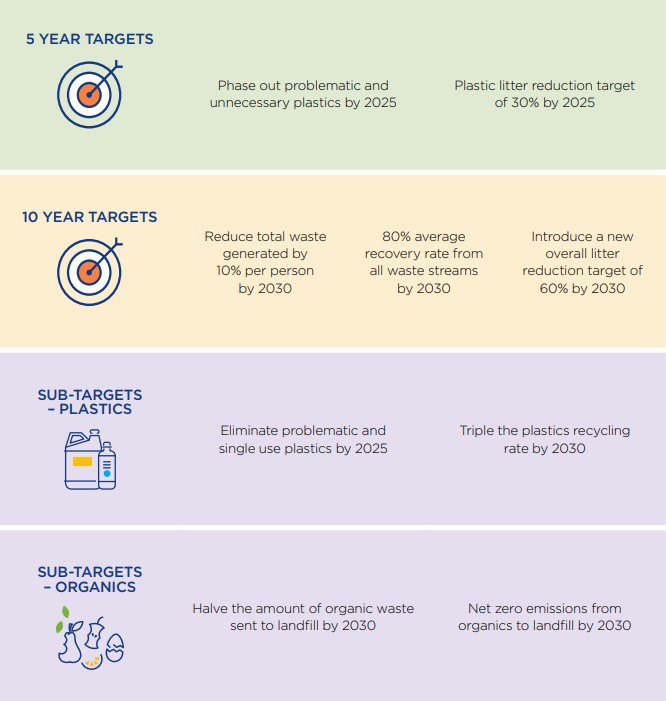
Figure: NSW WaSM Targets
(Source: NSW Waste and Sustainable Materials Strategy 2041: Stage 1 – 2021-2027)
The State government has also committed to:
· Developing a NSW regional litter prevention strategy before June 2023;
· Reporting annually on the progress towards meeting these targets prior to a review of WaSM in 2027;
· Establishing new indicators to track the progress of infrastructure investment and cost of waste services; and
· Developing a new measure of the emissions performance of waste and materials management which tracks performance across the lifecycle of materials.
Mandating FOGO separation for all households and some businesses
Both the WaSM and the accompanying infrastructure needs guide focus on better management of organic waste. In 2019 an estimated 2.5 million tonnes of organic waste (such as food organics, garden organics, timber, and textiles) was sent to landfill. Emissions from organic waste decomposing in landfill make up more than 2 percent of total net annual emissions in NSW. Methane emissions from the decomposition of organic material in landfills can last up to 25 years in the atmosphere. WaSM indicates that increased diversion of organics from landfill and processing technologies like composting and anaerobic digestion are an important first step towards reducing emissions from waste.
The amount of organic material going to landfill can be reduced by collecting it separately and processing it at specialised organic waste facilities. WaSM recognises that many councils already provide a separate bin to collect garden organics from households and some (less than a third) also collect food organics.
Other organic material, like textiles and timber, finds its way into household bins. Audits of residential kerbside residual waste bins in the waste levy area in NSW show that:
· The proportion of food and garden organics waste overall was 41 percent in 2019; and
· Councils that provided a separate food and garden organics collection service had a far lower proportion of these materials in the residual waste bin (25 percent) compared to councils with only garden organics (41 percent) or no organics collection (54 percent).
To achieve the WaSM targets of halving food waste to landfill and achieving net zero emissions from organics in landfill by 2030, the government will require the separate collection of:
1. Food and garden organics from all NSW households by 2030; and
2. Food waste from businesses that generate the highest volumes, including large supermarkets and hospitality businesses, by 2025.
The government has committed to consulting with councils, businesses, and service providers on the best way to transition to these new arrangements, including the need for phasing in new or grandfathering existing contracts, managing the different needs of high-density housing, and working with service providers to ramp up processing capacity.
To help with the transition, the NSW Government will invest $65 million over five years from 2023. The funding will support the rollout of new collection services, the development of more processing capacity and a state-wide education campaign that will help households adjust to the changes and improve their recycling habits.
Infrastructure Needs
The transition to the source-separated collection of food and garden organics from households and source-separated collection of food organics from selected businesses will significantly increase the volume of clean organics entering the recycling system. Accordingly, there needs to be a corresponding capacity to reprocess this material.
Based on an assessment of waste and circular economy infrastructure needs over the next decade and beyond the government has identified three key areas to focus on – residual waste, organics, and plastics.
Recovery and recycling infrastructure will need to keep pace with demand and to support this there will need to be investment in new and upgraded facilities from now to 2030 to prevent any shortfall in capacity.
WaSM sets out three priority areas:
1. Meeting future infrastructure and service needs as waste volumes grow;
2. Reducing carbon emissions through better waste and materials management; and
3. Building on work to protect the environment and human health from waste pollution.
Getting the right infrastructure in the right place will be critical to recover, reuse and extend the life of most materials. The WaSM Guide to Future Infrastructure Needs 2021 reviews the waste infrastructure requirements in NSW to underpin change.
While investment will largely be driven by industry, the NSW Government will play a role to help investment in the right place at the right time. WaSM indicates that, commencing in 2021 the Government will undertake feasibility assessments and engage with the community, local government and business about the infrastructure investment needed to meet the demands. It will undertake a coordination role to attract the right investment at the right time. The early priority will be to ensure there is a pipeline of residual waste management infrastructure, but it will also target complementary recycling and reprocessing infrastructure to help meet capacity gaps. This will involve coordinating functions across government, such as investment attraction, planning, environmental licensing, and grant funding.
Plastics Action Plan
The
NSW
Plastics Action
Plan
supports the NSW
Waste and Sustainable Materials Strategy
2041. The NSW Plastics Action Plan outlines a variety of actions
to address plastic across all elements of the plastic lifecycle (production,
consumption, disposal, and recycling) including the following:

Figure: NSW Plastics Action Plan Actions
(Source: www.dpie.nsw.gov.au/our-work/environment-energy-and-science/plastics-action-plan)
There are four outcomes that will achieve better management of plastics, reduce the impacts on the environment and make the most of these resources, the outcomes are supported by six actions.
NSW Energy from Waste Infrastructure Plan
The NSW Waste and Sustainable Materials Strategy 2041 commits to the adoption of a strategic approach to the role of thermal energy recovery from waste to ensure it protects human health and the environment and supports the transition to a circular economy. The recently released NSW Energy from Waste Infrastructure Plan 2041 guides strategic planning for future thermal energy from waste facilities and outlines how the NSW Government will facilitate the establishment and operation of energy from waste infrastructure to manage genuine residual waste.
Waste can be thermally treated to recover the embodied energy in that material. The energy can be recovered as heat or as a solid, liquid, or gaseous fuel. These outputs can be used to generate electricity or used directly in machinery, vehicles, and industrial processes (NSW Government, 2021, pg. 2).
Energy proposals must represent the most efficient use of the resource, adequately manage the risks of harm to human health or the environment, and maximise the environmental, social, and economic benefits to communities.
‘Eligible waste fuels’ including biomass and residues are listed in Part 3 of the Policy Statement and defined in the Eligible Waste Fuels Guidelines. These are excluded from this Plan and continue to be permitted across NSW where they comply with planning and regulatory frameworks.
The plan aligns with the 20-Year Vision for Regional NSW. Thermal energy from waste facilities only be established, or permitted to operate, in key, identified priority infrastructure areas or by the exception listed as follows: West Lithgow Precinct;
· Parkes Special Activation Precinct;
· Richmond Valley Regional Jobs Precinct;
· Southern Goulburn Mulwaree Precinct; or
· At facilities that use waste, or waste-derived, feedstock to replace less environmentally sound fuels (including coal or petroleum-based fuels) thermally treated (or approved to be thermally treated) at the site, and the energy produced from the waste is used predominantly to power the industrial and manufacturing processes on-site, rather than exporting that energy to the grid.
The Parkes Special Activation Precinct and West Lithgow Precinct28 are located within the NetWaste region and may pose opportunities for the member councils.
Local Framework
Local Government Act 1993
The Local Government Act 1993 sets out the legal framework, governance, powers, and responsibilities of councils in New South Wales. Guiding principles for councils include:
· Carrying out functions in a way that provides the best possible value for residents and ratepayers;
· Planning strategically for the provision of effective and efficient services to meet the diverse needs of the local community;
· Working co-operatively with other councils and the State government to achieve desired outcomes for the local community; and
· Working with others to secure appropriate services for local community needs.
Councils may provide goods, services, and facilities, and carry out activities, appropriate to the current and future needs within their local community and of the wider public. The Act sets out the functions of councils, including its service functions such as, providing community health, recreation, education and information services, environmental protection, and waste removal and disposal. A council must also levy an annual charge for the provision of domestic waste management services for each parcel of rateable land for which the service is available.
28 West Lithgow Precinct was removed from the gazetted map but remains a priority infrastructure area.
APPENDIX C
Regional Contracts
REPORT TO NETWASTE COUNCILS (STEERING COMMITTEE) FROM NETWASTE PROJECTS COORDINATOR
DATE 4th November 2022
REGIONAL CONTRACTS UPDATE
Please refer to attached participation table regarding each Council’s involvement in respective contract arrangements.
Collection of Used Motor Oil Contract
Aim: Facilitate collection of used motor oil from collection centres across NetWaste region
Contractor: Cleanaway Waste Management Ltd
Contract Commenced: 19 September 2020
Initial Contract Term Expiry (2 years + 2 x 12 month extensions)
Current Expiry: 19th September 2022 first extension complete (all Councils)
Collection of Scrap Metal Contract
Aim: Facilitate collection of scrap metal from collection centres across NetWaste region Contractor: Sims Metal Management – Subcontractor for collection McCabe Transport Contract Commenced: 1 September 2021
Initial Contract Term Expiry (2 years +2 x 12 month extensions)
Current Expiry: 1st September 2023
E-waste recycling option – currently shredded at St Marys Depot service to continue – trial underway regarding co-reg participation and further recovery from E-cycle Solutions – Looking at Lithgow, Bathurst, Orange, Forbes, Parkes, Blayney, Oberon with infrastructure and transport pilot
Processing of Garden Organics & Wood & Timber
Aim: Facilitate mulching of garden organics from collection centres across NetWaste region
Contractor: AusShredding Pty Ltd
Contract Commenced: 14 November 2018
Initial Contract Term Expiry (2 years + 2 x 12 month extensions)
Current Expiry: 14 November 2022 – Tender is out, Closed 1 November with assessment taking place for scoring
Joint Environmental Monitoring of Licensed Landfills Aim: Monitor of licenced landfills for 9 NetWaste Councils Contractor: Premise Pty Ltd
Contract Commenced: 1 July 2022
Initial Contract Term Expiry (3 years + 2 x 12 month extensions)
Current Expiry: 1 July 2025
Regional Waste Services Contract
Aim: 9 Councils initially involved in a regional tender for mix of domestic waste, recycling and organics collection and processing services.
Contractor: JR Richards for collection, ANL for processing of organics for Bathurst, Parkes Forbes, and Blue Mountains
Contract Commenced: 4 April 2016
Contract Term Expiry (10 years): 3 April 2026
Contract service collection commenced 4 April 2016 in Bathurst, Blayney, Cabonne, Forbes, Orange and Parkes. Dubbo, Narromine, Lachlan additional contracts.
Quarterly regional contract meetings are held between participating Councils and JR Richards (collection contractors). New Visy supply agreement commencing 1 July and currently under review.
Collection and Recycling of Waste Tyres
Aim: Collection and recycling of waste tyres from Council depots and waste facilities across the NetWaste region
Contractor: JLW Services Pty Ltd
Contract Commenced: 1st May 2020
Initial Contract Term Expiry (2 years + 2 x 12 month extensions)
Current Expiry: 1st May 2022. (1st extension agreed upon)
1st Extension expiry: 1st May 2023

Collection and
Recycling of
Mattresses
Aim: Collection and recycling of waste tyres from Council depots and waste facilities across the NetWaste region in conjunction with NIRW.
Contractor: JLW Services Pty Ltd
Contract Commenced: 24th September 2019
Initial Contract Term Expiry (2 years + 2 x 12 month extensions)
Current Expiry: 24 September 2021 (1st extension agreed upon)
2nd Extension expiry: 24th September 2023 – Final extension agreed upon
2023 Household Chemical Cleanout
Funding proposal being compiled to EPA look at 100K funding
RECOMMENDATIONS
1. That the report be noted.