Cost of new metro lines blows out by more than half a billion dollars
SMH -
Matt O'Sullivan
March 24, 2025 - 66 Comments
The cost of major contracts for two of Sydney’s signature metro rail projects has blown out by $566 million, underscoring the budgetary pressures on the NSW government from the construction of new lines for driverless passenger trains.
Tender documents reveal the predicted cost of tunnelling works at the western end of the Metro West rail line between Parramatta and the Sydney CBD has surged by $353 million from its original estimate to $2.7 billion.
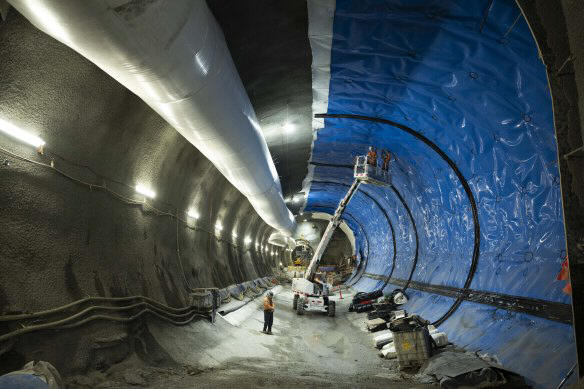
The Metro West rail project is due to be completed in 2032
Another contract for about 2.5 kilometres of tunnels under Pyrmont and the CBD, as well as station excavations and other works, has risen by $90 million to $1.88 billion.
Forming the fourth stage of Sydney’s metro network, the 24-kilometre line is the largest rail project in the city and due to be completed by 2032, which is two years later than earlier forecasts.
Tender documents also show a $123 million jump to $2.14 billion in the estimated cost of tunnelling and station excavation contract for the 23-kilometre metro line to Western Sydney International Airport.
Coalition transport spokeswoman Natalie Ward said the financial strain on Metro West cast serious doubt over how the government plans to fund an extra station at Rosehill, near Parramatta, without making deeper cuts to critical transport and road infrastructure.
“With transport investment already slashed by 34 per cent, the opportunities for new projects are rapidly shrinking,” she said.
Sydney Metro said in a statement that extra costs on the Metro West project included the delivery of extra cross passages in tunnels and bulk earthworks, as well as contamination management.
“The current budget envelope for Sydney Metro West includes contingency to manage unforeseen and forecast risks to the project including future contracts,” it said.
The agency said the increase to the airport line contract was primarily due to extra cross passages in tunnels and was within the project contingency.
Tunnels for the new metro rail line to Western Sydney Airport.
It decided in early 2023 to build cross passages about 240 metres apart in tunnels for the airport line and Metro West after NSW’s fire and rescue agency warned of safety risks to emergency workers if they were half a kilometre apart.
Transport Minister John Graham said adjustments to contracts included important works that address feedback from emergency services.
“Metro West blew out by $12 billion when the Liberals were in government. We are working to keep a tight lid on costs and delivery, but certainly won’t be taking lectures on project management from the former government responsible for that blow out,” he said.
Revealed: Sydney’s busiest metro stations during the morning rush
Sydney Metro executives recently told a budget estimates hearing two weeks ago that analysis provided to the government showed Metro West risks costing more than its $25.3 billion budget. However, they said that both Metro West and the airport line project were tracking within their budgets of $25.3 billion and $11 billion respectively.
The Metro West budget does not include the cost of a possible station at Rosehill, which hinges on a vote on April 3 by Australian Turf Club members on controversial plans to sell the suburb’s racecourse to create 25,000 new homes.
The cost of a station at Rosehill has been estimated at between $1.5 billion and $2 billion, according to a highly confidential review into Sydney’s mega rail projects in late 2023.
Late opening for $11 billion metro line to Sydney’s new international airport
In a sign of the cost and construction pressures on the rail projects, the Minns government committed an extra $1.1 billion in late 2023 to complete the conversion of the heavy rail line between Sydenham and Bankstown to metro train standards.
It pushed the price tag for the entire M1 line between Chatswood and Bankstown to $21.6 billion, almost double an original forecast of $12 billion when the project was announced last decade.
3 Reader Comments
Sydney's metro lines are per kilometre, the most expensive in the word.
Take for instance the very similar Copenhagen Metro. Two tunnels with a diameter of 5.78 m and a length of 15.5 km each were bored through the Copenhagen limestone. The total cost of the Cityringen project amounts to 3.2 billion euro, approximately $5.5 billion Australian or $177 million per kilometre.
The London Crossrail project ultimately cost £18.8 billion or $38.7 billion for 118 kilometres including 42 kilometres of track in new tunnels with an overall cost of $328 million per kilometre.
Sydney Metro West: Estimated cost of $25.32 billion for 24 kilometres or $1.05 billion per kilometre.
The 23 kilometre $11 billion line to Western Sydney Airport: $458 million per kilometre.
For comparison the 11.4 kilometre South West Rail Link (Glenfield to Leppington) cost $2.1 billion to build or $184 million per kilometre, similar to the cost of the Epping to Chatswood line completed in 2009.
These figures demonstrate that Sydney's driverless metros are ridiculously expensive and rail services - such as the line to the new airport - should have been built as extensions of the existing system.
The most rational decision the government could take is to complete Sydney Metro West as an extension of the existing system and abandon any plans for new metro lines that are as these figures demonstrate, outrageously expensive.
The government hiring major consortiums, employing major contractors who are employing sub contractors, who are quite often hiring even more sub contractors and when completed hiring a third party operator to run the operation…..all of whom are making individual profits. Why is it so expensive to build infrastructure again? There’s got to be a better way.
In recent times, the names Berejiklian and Constance were synonyms for the queen and king (or should that be prince, or duke?) of big cost overruns on NSW public works builds.